What Good Is a Story If No One is Listening?

Is it just me, or is our world is going out of its way to show off its ugliness these days?  Even when you try not look, it’s yelling at your back.  The age old horrible stories are bubbling to the surface and blasting us all with a scalding steam made all the more intense by our long efforts to keep them bottled up down below.

Okay, I hear youYou’re there.  And okay, I’m here, and I’m making my shameful confession:  I, a so-called storyteller and lover of tales, am a horrible listener.

There are so many things I would rather do than listen.  I want to fix.  To act.  To solve the problem.  To make it go away.  To move on.

If I can’t, I don’t want to hear about it.  I don’t want to feel helpless.  I don’t want to feel unresolved pain.  I don’t want to feel impotent rage.

For someone who claims to value stories, there are so many of them I’d rather not hear.

What is wrong with me?

I’m no one really, a small person with a small life, so for me this starts small, in my home, with my kids.  You know that thing, where they get into a fight and you hear them screaming at each other and it reaches a level that you can no longer ignore so you go up the stairs and ask what has happened and the second they say, “I was playing with this and he took it!” you launch a lecture on taking turns and pass a quick judgment on who will get the first turn and in the end both kids are unsatisfied and their anger has now turned against you? (Please tell me I’m not the only one who does this.)

Here’s the thing: it is true that their argument is petty.  It is true that they need to take turns.  It is true that they need to stop overreacting and stop being selfish and stop making our house an unpleasant place with their yelling.  But am I really helping?  In my calmer moments I realize that I could choose to stay out of it altogether and give them the freedom to resolve their problems without an authority involved.  I could turn away the tattler and close my ears to the noise.  That’s teaching them something constructive and I do it whenever I can.  It’s also just not possible sometimes.  Things escalate, they get out of hand.  So if I’m going to get involved, then I have to make the most of my involvement.  Do I want to teach them about resolving conflict appropriately?  Refusing to listen to them and rushing to judgment is probably not doing the trick.

I recently read this article by Doug Lipman about story listening, and it really blew my mind.  In it, Lipman recounts the supposedly true story of a rabbi who is resolving a dispute between two villagers.  After carefully listening to each villager, asking many questions, and not letting either one finish until he has nothing left to add, the rabbi comes to a quick resolution which satisfies them both.  Later, an observer asks him why he let them talk so long when he obviously knew the solution all along.  “The rabbi said, ‘If I had not listened to each one’s full story, each would have resented my decision. It wasn’t my judgment that solved the problem. What solved it was listening to their entire stories.’”

Oh.

Yeah.

Imagine how much better things would be if I let my kids tell their full stories.  If I didn’t rush them, interrupt them, get irritated by the insane amount of detail they want to provide or the over-the-top emotions that come along with it.  Imagine if I asked them to tell me what was going on and really listened.  Imagine if I showed them that their point of view matters to me and that I want to feel what they feel.

Imagine how much better things would be if we let everyone tell their full stories.  If we didn’t smile distantly and back away, immediately jump in with our own defensiveness or devil’s advocacy, get irritated by the insane amount of detail they want to provide or the over-the-top emotions that come along with it.

Imagine if we asked for people’s stories, and we really wanted them to answer.  Imagine if we listened and didn’t try to fix their lives.  Imagine if we let the story lie there, let the pain be raw, let the injustice rankle, let the anger burn us to the core, and just left it there, existing, being a real thing.

For just short time, we would be actually sharing someone else’s life.  Through the power of story, we would get it for just a minute.

And then it would be gone.  We would be back inside ourselves and bound by our own experiences, but we would never be able to forget the connection of that one moment.  And that could be repeated.  And repeated.  And repeated.  Until being connected felt normal and being isolated no longer fit us.

I know you want that.  I know I want that.  I know it’s the getting at it that’s so terribly hard.

How do you encourage people to tell you their stories?  One blogger suggests that we get rid of asking strangers “What do you do?” and start asking them “What is your story?”  I like the sentiment, but I can’t help feeling that people would be put off by such an enormous question on a first meeting.  (The post makes for great reading, though, just for the lovely comments answering the question.) So how do we ask?

Where are you from?
What brought you here?
Are you happy you came?

I don’t think it matters what question you use.  It only matters how much attention you pay to the answer.  People are dying to be understood; they want their stories known. They may not know how to tell them. The certainly may not know how to tell them in an interesting way or a concise way or a way that is palatable to us, but if we listen and keep asking and then listen some more, we’ll see the storyline begin to emerge, and maybe we’ll be surprised at how captivating it is.

Or maybe we won’t.  Maybe we’ll be bored.  Maybe it will make us mad.  Maybe it will make us late.

Who cares? We’ll have shown that stranger (or neighbor or co-worker or friend or family member or postal worker or waitress) that their life matters to us.  We’ll have shown them that their story is worthy of being told.

Seriously, what were we going to do today that was more important than that?


P.S.  If you aren’t sure where to start, listen to some stories that people have recorded for you.  Remember I told you about the Life Stories Project?  Check out these ones from African-American Hoosiers.  Most of them are only 4 or 5 minutes long.  And don’t miss this one, even though it’s a little longer.  This is MY city.  These are MY people.  Listening is the least I can do.


May Your Children Be Storytellers

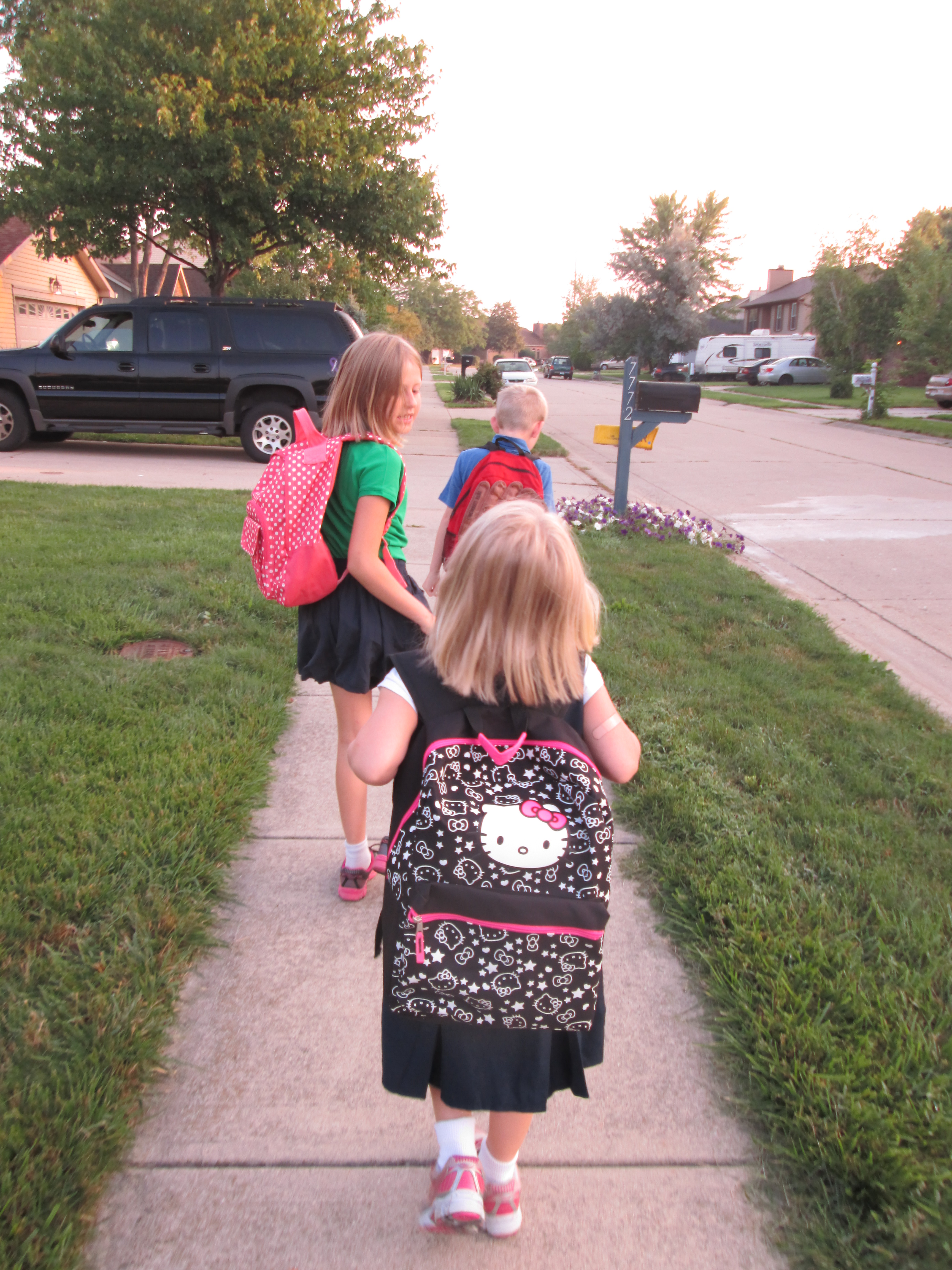
Two weeks ago, my baby started Kindergarten.  She got up in the morning, put on a school uniform, ate a very small breakfast (nerves!), slung her new backpack over her shoulders, marched down the street to the bus stop, gave me one last sweet hug and kiss, and climbed onto the bus behind her big brother and sister.

The bus drove away.  I stayed on the corner.

IMG_0389

(Here’s where I reassure you that this is not a post about the pain of motherhood and letting go.  I did feel a little sad.  My quiet house felt extremely weird.  I also felt happy.  And free.  But this is not about what I felt.  Feelings.  Who needs them?)

My baby had a whole long eight-hour day, and I was not a part of it.  I also had a whole long eight-hour day.  She wasn’t a part of it.  Then she got back off the bus at 3:08.  I took her hand.  We walked home.  We were together again, but that gap, that eight-hour gap, it was there.

She has her own life now.  Her own story.

It happens sooner with some children than with others.  This one, my baby, more so than my other children, has had her story tightly blended with mine for longer than most.  We’ve had hours, even days, apart, but not with any regularity.  Her story, the overarching sum of her waking moments, was witnessed by me, and I was its chief supporting character.  All that is changing now.

I’m not afraid.  A little sad, maybe, a little sentimental, but not afraid.

Because I always had a story separate from hers.  I had years of story before she was born and hours each day while she slept.  So many things have shaped me and remade me, and she never experienced any of them except through the tales I chose to tell her.  But I have told her tales.  True tales of me.  True tales of my life.  True tales of my imagination.  Some I am saving for when she is older, but she knows enough.  She knows enough to know me.

And so I trust that she will do the same.  For the first time, she has tales to tell me that I don’t already know.  And as she chooses to tell them, that eight-hour gap, the one that is multiplied by all the days, is filled in.  I don’t know every detail, as I did when I lived it with her, but this is better really.  Now her story is coming to me through her filter, and not through mine.  I hear only what she finds important, what rings in her memory, and it is colored by her brain, her wonderful, magical mind.

Why do we tell stories?  Because we want our children to be storytellers.  How else will we really know them?


Storytelling in Indiana

This one is for you locals because I just found out about it and I really, really want to make sure you haven’t missed this.  Did you know Indiana has an organization called The Storytelling Arts of Indiana?  I’ve been spending way too much time lately over on their website, and I want to make friends with each and every one of these people.

They have an index of local storytellers you can hire for school (or homeschool) storytelling visits.

They have GREAT resources for teachers, including some awesome lesson plans for teaching storytelling and (even better) using storytelling to teach other things.  That’s the page where I lost myself for a while, and I’m not even a teacher any more.

They also organize a ton of storytelling events around the state.  They just finished this years Annual Liar’s Contest at the Indiana State Fair.  There is no way I’m missing this next year.  You show up, you register, you tell your best whopper, you get judged, and winners get a prize.  It’s for adults and children, and even if you don’t want to participate, how fun would it be to listen?

They also have monthly Jabberwocky meetings, “a gathering of “jabbers” willing to share their life stories based on a different theme each month throughout the year.”  They do these in two different Indianapolis locations.  I’m so in.

And as we head into fall, Indianapolis residents should consider Ghost Stories at Crown Hill Cemetery.  Um…how much would my kids love this?  This one isn’t free.  It isn’t even cheap.  But it’s no more expensive than taking my whole family to a movie, and you get to bring a picnic and shiver together under a blanket in the October chill.  Sounds good to me.

Okay, I’m done raving, but seriously, check it out.

Also, have you heard about the Life Stories Project?  True stories of everyday people. You can go online and listen to the ones they’ve recorded so far (searchable by topic as well as author and date), and if you’re interested in recording your own story, they have scheduled time and places to record.  I plan to spend some serious time this week listening to stories.

Can I be honest with you here?  I haven’t always enjoyed living in Indiana.  I’m just really not from around here.  But the last few years…I’m having a harder and harder time coming up with reasons not to love it.  And I think today I may just have decided to claim the title Hoosier after all.

(As always, I’m not paid in any way to rave about these things.  I’m just a lunatic who’s happy to rave for free.)


Ssebastian

Once upon a time there was a baby snake named Ssabastian.  For the longest time he looked exactly like all the other snakes.  His skin was green and brown.  His body was long and skinny.  His tongue was pink and forked.  Ssebastian’s mother loved him very much and taught him all about how to hunt for small animals to eat and how to stay out of the way of dangerous birds of prey.

As Ssebastian grew, he got very good at hunting for small animals.  Very, very good.  He often caught dozens of mice each night, not to mention the odd squirrel or chipmunk.  And since he always ate everything he caught, Ssebastian grew at an alarming rate.  His mother was alarmed.  His friends were alarmed.  It goes without saying that all the small animals in the forest were extremely alarmed.

Ssebastian grew and grew and grew.  The bigger he got, the better he was as hunting.  Soon he could catch rabbits and then racoons, and once he even caught a fox.  By this time, Ssebastian was longer than the old pine tree which had fallen over just before his birth and nearly as big around.  Ssebastian’s mother still loved him very much, of course, and now she began to worry that he would attract attention from something far more dangerous than birds of prey: humans.

Luckily, Ssebastian’s mother was a very intelligent snake.  She decided to make a disguise for Ssebastian.  Taking the bark off of many fallen trees, she pieced together a new skin that Sebastian could slither inside.  When he did this, if he lay perfectly still, he looked just like a fallen tree himself.  In this way, she planned to protect him from the notice of humans and so keep him from being killed out of panic or worse, put into a zoo for children to gawk at.

Ssebastian liked his new disguise.  It was fun to pretend he was a tree, at least at first.  He lay very still and smelled the lovely sappy smell of his bark and watched the clouds go by overhead.  After a while, though, he started to get tired of lying still, and his skin began to itch.  He longed to slither through the forest and to coil around the trees and scratch his skin on their branches.

Ssebastian looked around at the other trees.  He saw how they swayed in the wind and thought to himself that he didn’t need to be a fallen tree.  He could slither around in his disguise and be more like a living tree which moved back and forth as much as it wanted.  So Ssebastian began to move.  First, he just rolled over, and that felt so good that he slithered over to some trees and arched against them.  Their bark scraped against his in such a pleasant manner that he stretched higher and higher, reaching for their branches.  He let the branches brush against the back of his head and then ducked his head down and let the branches slide down his back.

IMG_1270

At this exact moment, two human children came walking through the woods.  Ssebastian froze when he saw them coming.  He was in a very compromising position: his tail in the trees, his back swooped down low and then arched high into the air, and his head ducked down in the grass.  It was too late to move, though.  The children had seen him.

Luckily, his bark disguise was very well-made.  The children began to exclaim about the cool shape of this tree, and Ssebastian thought he was home free when suddenly they started to climb on him.

“Come here!” said one child.  “We can slide down it!”

“I’m going to do flips!” said the other child.

“Bet you can’t hang by your ankles!” the first child answered.

They did.  They did all those things.  Poor Ssebastian had to hold perfectly still as the children slid down his back and climbed up again, as they gripped his bark and swung back and forth, as they bent their knees around his middle and hung upside down.  His back was hurting dreadfully, and he didn’t know how much longer he could hold his position.

Now Ssebastian was a very kind and friendly sort of snake (friendly toward everyone except small animals, of course, and even that was only because he was so hungry all the time).  As uncomfortable as he was, he actually found himself liking these little humans.  They laughed and shouted and sounded like they were having so much fun that he could hardly stop himself from trying to join in.  He tried to remember all of his mother’s warnings, and to think about her stories of the horrible zoo, but between the pain in his crooked back and the sound of laughter all around him, he couldn’t seem to remember what was so bad about these humans.

All at once, Ssebastian let his back drop, lightly setting down the child who had been clambering up it.  It felt so good to finally be released that SSebastian rolled over twice and let out a hissss of pleasure.  The children screamed.  Very loudly.  SSebastian curled around them protectively, just as his mother had done for him when he was scared as a tiny snake.  The children screamed even louder and started kicking his sides.  Ssebastian thought maybe this was a new form of play and tried to nuzzle the children with his head.  They screamed louder than any noise he had ever heard.  Then one of the children grabbed a stick and started hitting Ssebastian.  This broke open some of Ssebastian’s lovely bark disguise.  The children kept on yelling.

The nose was beginning to be almost as painful as the climbing had been, and if these children kept on hitting him, his whole disguise would be ruined.  Ssebastian realized now why his mother had wanted him to remain unseen.  He wished he had listened to her.  He wondered if it was too late to pretend to be a fallen tree again.  He decided to try it.

Ssebastian lay completely still on the ground, stretched out straight and flat.  The children cried in triumph.

“I killed him!” yelled the child with the stick.

“He’s dead!” yelled the other child.

“Let’s go tell Davey that we killed a snake as big as a tree!” yelled the first child.

The two children ran off through the trees to brag of their adventure to all their friend, none of whom, fortunately, believed them.

As for Ssebastian, he had learned his lesson.  His mother made him a new bark disguise, and Ssebastian spent many long hours lying silently inside it, resting and thinking about the peaceful lives of fallen trees.  Only at night, when it was too dark for anyone to see him, did he come out to do more hunting.  This restriction in his hunting time was a good thing for everyone.  The moderation in his diet kept Ssebastian from growing even larger than he was, and the small animals of the forest, of course, were quite relieved.

How to Tell A Story: The Picture Brainstorming Method

Okay, visual learners, this one is for you.  Just because you think in pictures instead of words, you aren’t shut out of the storytelling world.  You have stories in you.  You just need to access them in a different way.  With this method, you’ll get to use a picture, which will probably speak to you more, and if you get stuck on the rest, you can always get your kids (or your friends) to help you with the brainstorming.  Kids are very useful for brainstorming (which is good because they aren’t so much help with chores).

To be honest, this one is pretty great for all kinds of brains.  I’m not particularly visual myself, but I still use this method probably more than any other.  Are you ready?

You start with a picture.  Any picture, really, but it helps if it’s of something unusual or in some way particularly appealing to you personally.  I often troll the internet for inspiring pictures (and collect many of them here).  I also take advantage of my amazing photographer friends.  But the picture doesn’t need to be professional.  For today’s example, we’ll use this low-quality snapshot I took with my phone when I was out walking a few weeks ago.

IMG_1270

Cool tree, right?

So here’s how it goes: we look at the picture and we just start asking questions.  The first question is easy.

What is this?

Now write down (or keep it in your head if you can do that sort of thing) as many answers to that as you can think of.  Don’t skip over the obvious.  Don’t discard the ridiculous.  Not yet.

What is this?

  • a twisted tree
  • a giant snake posing as a tree
  • a backwards letter N
  • a sideways letter S
  • a doorway to another world

Now, pick an answer you like and apply the second question:

Why is it here?

You’ll probably have several possible answers to this, too.  Try it out with several of your original “whats” and see which story appeals to you the most.

Why is this twisted tree here?

  • a giant sat on it
  • it grew around a rectangular object which was later taken away
  • a wizard twisted it and turned it into a doorway
  • it got tired and drooped over
  • it’s made out of rubber and kids have been playing with it

Why is this giant snake posing as a tree?

  • It’s on the run from a giant eagle who wants to eat it
  • This is how it lures in tired travelers, posing as a seat, so it can eat them

Why is there a backwards letter N in the woods?

  • The man who planted this was named Nick and wanted to be remembered
  • It’s all that’s left of the words NO TRESPASSING, a warning left by elves long ago to keep people out of their woods

Now just pick one of these many, many story ideas and keep applying the questions:

What? Why? How?

Sticking with the most ordinary of all our responses:  This is a twisted tree which grew around a rectangular object that is no longer there.

  • What was the object?
  • Why was the object there?
  • How did the tree grow around it?
  • Why was the object taken away?
  • What will the tree do now?

Again, unless a story just jumps out at you and starts telling itself (this is a thing that happens), you should brainstorm several ideas for each answer.  That way you can find one that’s silly, funny, tragic, terrifying, or inspiring (depending on how you like your stories).

What was the object?

  • Sponge Bob Square Pants
  • A refrigerator
  • A coffin
  • A door
  • A swing set
  • A window
  • Han Solo frozen in carbonite

And that’s all there is to it.  A picture.  A few questions.  As many answers as you can dream up.  String it all together, and you have a story.

Get yourself over to Tumblr or Pinterest or your favorite photography blog (or your own photo archives for that matter) and give it a try.  Even if you don’t feel brave enough to tell anyone your story, I bet you’ll have fun.  This is one thing that always makes my  brain happy.  It might make yours happy, too.

Also, check back on Wednesday.  I’ll make a real story out of some of these brainstorming ideas.  Any votes on which ones?


Another Way Devices Are (Not) Killing Creativity

IMG_1462

Once they get hooked, there’s no stopping them.  Morning, noon, and night they’re begging for more.  What can you do?  It’s the way of the world.  Stories are just that much fun.  (And yeah, video games, too.)

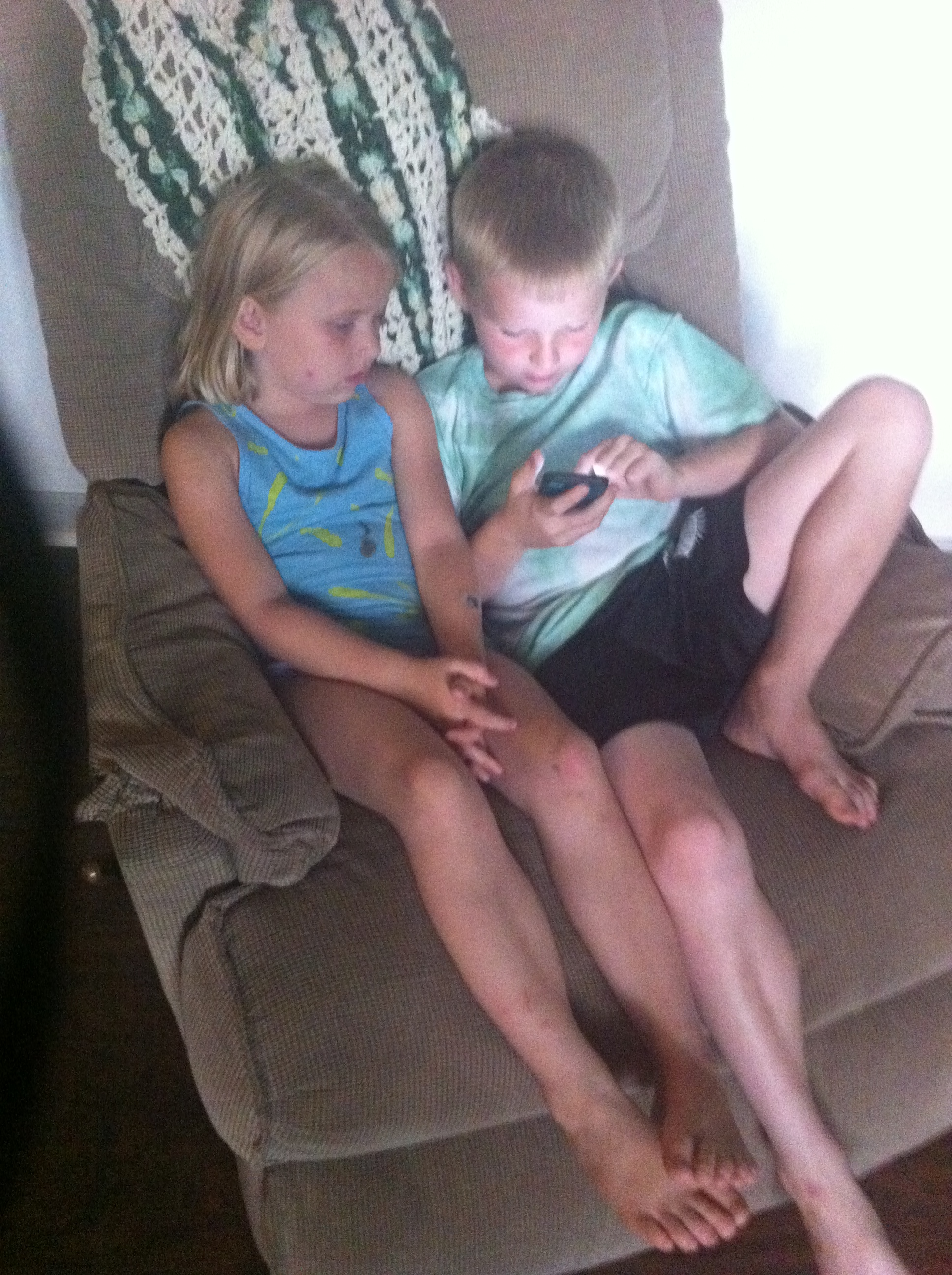
See them up there?  They actually aren’t playing a game.  He’s telling her a story.  I wish I could take credit for this.  I wish I could say I came up with a fun way to use technology to promote creativity and storytelling.  But this?  This they did all on their own.  Once you start with the stories, it all sort of takes on a life of its own.

doodlebuddyThese two use the DoodleBuddy app.  You know this one?  It’s free and really basic, and we kept it on our devices for them to use when they were little and we were desperate to distract them while we actually spoke to other adults for a while.  It was great for that, but they quickly outgrew the doodling aspect of it.  That’s when they started making up stories.

screen320x480The cool thing about DoodleBuddy is that it has these stamps.  Preset pictures that you can put anywhere on the screen, and (if your parents don’t make you turn the volume off because, annoying) each one makes a little sound effect when you use it.  So they fill half the screen with trees and it’s a forest.  Then the forest is infested with ladybugs.  But the sun comes out and kills of the ladybugs and…on and on and on. The pages of pictures themselves suggest new plot points.  Forest fire?  Rain?  That’ll work.

They tell them to each other.  They tell them to me.  I even hear them open it up and mutter the stories under their breaths to themselves.

So there you go.  A good idea from my kids to yours.  Next time you’re waiting in line for the oil change or hanging out in a dangerously overcrowded restaurant, give it a try.  It just might save the day.

Campfire Tales: Because We All Need A Little Fear

IMG_3053

The floorboards creaked as the mysterious footsteps came closer. The doorknob turned.  The children looked for some place to hide, but there was no time.  A hand appeared, its long claw-like nails scraping the wood of the door as it pushed it slowly open…

It doesn’t even matter how this story began.  This bit is enough to show that my kids love it.  Why?  Because they are shivering in their seats.  Oh, how they love that shiver.  And how I love the look of mingled terror and delight on their faces.  Their hearts are pounding.  They are shifting in their seats.  Though they don’t understand it themselves (and really, neither do I), their brains have felt their fear and gone into fight or flight mode, sending adrenalin coursing through their little bodies.  They are lit up, not dangerously so, but enough to feel the thrill.

By scaring my children, just a little, I’ve made them feel more alive.

The littlest child hid her face, while her older sister looked bravely ahead, determined to defend herself and her little sister against whoever….whatever…was coming through that door.  Seeing a hairbrush on the bedside table, she snatched it up, gripping it tightly as a shriveled arm followed the gnarled hand through the door…

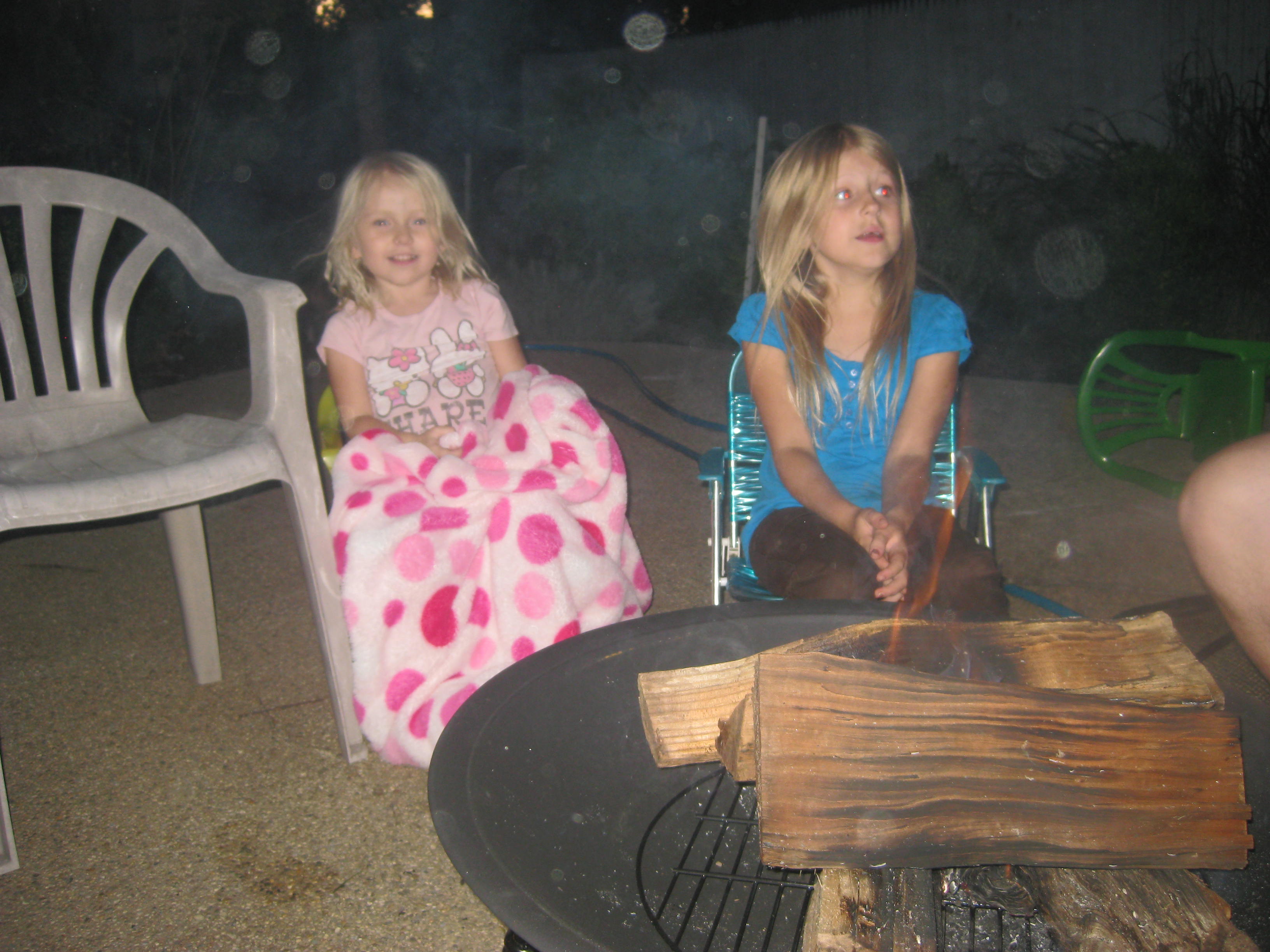
This would be about the point that my five-year-old would bolt from her seat and skirt the fire to come and cuddle on my lap.  My son would make a joke to break the tension, and we would all laugh.  My oldest daughter would roll her eyes and then shush him, eager to hear the ending.  When the end does come, we’ll all exhale.  Then we’ll all talk at the same time for a few minutes.  Then it will be someone else’s turn for a tale.  The kids stories will inevitably include elements from mine, turned their own way, but recognizable just the same.  For days after, we’ll remind each other of our favorite scary moment.  At the next campfire, someone will say, “Remember the last campfire story?”  It’s more than just a story, it’s a shared moment of high emotion, a moment when we looked to each other for reassurance, some of us pretending we didn’t really need it, but we looked just the same.

By scaring my children, just a little, I’ve brought us together as a family.

The horrible creature that entered the room was like nothing the children had ever seen.  Hunched over and shuffling slowly toward them, they couldn’t take their eyes off of its wrinkled gray skin and the disgusting matted hair that obscured its face.  The older sister raised the hairbrush threateningly…

It doesn’t even matter how the story ends.  Perhaps the creature attacks and they are successful in fighting it off.  Perhaps someone comes to rescue them.  Perhaps it turns out that the creature was friendly in spite of its appearance.  In any case, the children end up safe and sound, their fears overcome.  My kids will feel the release of tension.  They’ll grin with relief as they feel the empowerment of victory.  If I were a slightly different person, it could end with the children being mercilessly slaughtered, I suppose.  That’s the next level of terrifying, but even so, the story ends.  My children look around.  They are all still alive and with their family and safe.  One more horrible thing that hasn’t harmed them, in spite of what it’s done to others.

By scaring my children just a little bit, I’ve made them feel safer.

(Parents, I know you remember the ghost stories that scared you as a kid.  Try them out on your kids, if you don’t feel up to making up your own.  Or check out these well-known legends .  And if you are interested in more thoughts on why we tell scary stories, listen to these fascinating clips from a talk given by Neil Gaiman.  His very way of speaking will give you a little shiver.

How To Tell A Story: The Topsy-Turvy Method

I mentioned this method on Friday when I told you about the wonderful little book, My Lucky Day, by Keiko Kasza.  Today we’re going to bring it to life and hopefully I can convince you to try it on some unsuspecting kid in your life.

This isn’t going to be as structured as the boringly-named “Four Step Method.”  In fact, it isn’t structured at all, so if it doesn’t work for you, go back to that one for now.  Still, I think topsy-turvy is pretty fun for generating new and interesting ideas.  Or at least new and silly ideas.  Which is even better if you’re a kid.

So here’s how it works:  You pick something ordinary, anything from your day or from nature or from well-known fairy tales or from old college textbooks.  Anything.  Then you turn it upside down.  Follow the upside down trail and see where it goes.  That’s it.

So:

  • You eat your food and drink your water at lunch time = you drink your food and eat your water
  • You brush your teeth = Your teeth brush you
  • The early bird gets the worm = The early worm gets the bird
  • The waterfall cascades over the cliff = the water leaps up the cliff
  • Cinderella can’t wait to escape her step-mother and marry the prince = Cinderella wants to stay with her step-mother but the prince kidnaps her

These can go in all directions.  You can tell the story of why:  Why would you need to drink your food and eat your water?  Why would the water be going up instead of down?  Or you can tell the story of how:  How exactly does a worm get a bird?  Or you can tell the story of what happens next: How does Cinderella escape the prince and get back to her lovely step-mother?

Or you can just tell what happens with no explanation at all.  Let’s take the teeth brushing example:

Once upon a time there was a family of teeth.  There was Mommy Tooth, Daddy Tooth, four very old Wisdom Teeth, and twenty four brother and sister teeth.  The littlest tooth was only four years old when Mommy Tooth said, “You’re big enough now that it’s time you started brushing your person.”  “Aw, Mom,” said Littlest Tooth.  “I don’t want to brush my person.”  “Hush,” said Mommy Tooth.  “If you don’t brush your person, your person will be dirty and will smell bad and maybe will even fall apart, and then where will you be?”  So the Littlest Tooth brushed her person, just as she was told, but she grumbled because it seemed like a waste of time and she would so much rather be chomping.  After many days of brushing her person like a good little tooth, Littlest Tooth noticed that Mommy wasn’t really paying much attention any more.  She decided it wouldn’t hurt to skip brushing for just one day, so she went off biting with her sisters instead.  The next day, she thought that skipping two days wouldn’t cause much damage, so she decided to chomp with her brothers.  So it went on for many days until one day, Littlest Tooth noticed that her person was looking extremely dirty.  Her mother noticed, too.  “You haven’t been brushing your person, Littlest Tooth,” her mother scolded.  “Now we will have to take your person into a special person doctor to get it repaired.”  Littlest Tooth was afraid of the person doctor, but there was nothing else to be done.  Into the person doctor they went.  The person doctor shook his head and said, “You haven’t been brushing your person, have you?”  Littlest Tooth felt ashamed.  “I will do my best to repair the damage,” said the person doctor, “but you really must do a better job from now on.”  “I will,” said Littlest Tooth.  So all day long, Littlest Tooth had to sit at the person doctor while he worked on cleaning up her person.  It was very boring.  She wished she were biting.  She wished she were chomping.  But she couldn’t do any of those things without her person.  When that long, long day was over, Littlest Tooth went home with her shining clean person and gave it a good brushing, just to be safe.  And she never forgot to brush her person again.

Is this story ridiculous?  Yep.  Is it super weird?  You bet.  Does it have a plot?  Not really.  Does it at all explain how a tooth could brush a person?  Not a bit.  Would my five-year-old like it? She sure would.  And I’m guessing that she would have some mental image of a tooth brushing a person that would be way more interesting than anything I could come up with.

That’s all there is to it.  Next time you need a story and are stumped for an idea, turn something ordinary around.  What do you think?  Are you up for it?

It’s Story Time: When They’re On Overload

IMG_9646My kids are really emotional.  Yeah, I know, saying kids are emotional is like saying that the sun rises in the east in the morning, but even though that’s a natural and predictable phenomenon I still contend that if the sun shot up over the horizon all neon pink and sparkly, you’d think it was worth mentioning.  Also, if, while you were staring in blank amazement, it suddenly grew dark and began to weep hot lava because the sparkle and pink hadn’t come out exactly the way it planned, that would be a much better comparison to my kids.

So basically, a whole lot of my parenting life has been spent trying to come up with ways to help them control their emotions.  I’m not naming names, but they each have a specialty: freaking out over things not turning out the way they planned, or freaking out over things they are worried might happen tomorrow, or freaking out over the itchiness of their shirt and the fact that their food is touching other food.  It’s a lot of freaking out.

This isn’t a parenting manual, because, really.  This is just me saying that after trying soothing voices and counting and reasoning through things and losing my cool and shouting with varying degrees of effectiveness, one of the things I’ve discovered really helps is distraction.  When they were toddlers, a favorite toy might work, but now I have to work a lot harder.  Also, when they are worked up they don’t want to be calmed down, so I have to be somewhat sneaky about it.

This is where stories come in.

I’m not talking about “Once upon a time” stories, though that can still work with the five-year-old.  The older kids find that to be too much of a non-sequitur and therefore suspicious.  I’m also not talking about moralistic tales.  “Let me tell you about the boy who cried wolf…”  They are too smart not to see that for a lesson wrapped thinly in fiction.  Usually this is where I bring out stories from my own life.  They only have to be tangentially related to the situation.  They really don’t have to be related at all.  All they have to show is that one time I felt the way they feel.  But I add in lots of details and drag it out so that they are thinking about something other than their situation, and if it’s possible to make it funny along the way, I do.  Then sometimes we can actually end up laughing together and all is well.  Or at least they are rolling their eyes at me, which is a BIG step up from panic breathing or angry raging.  I’ve actually come to appreciate the eye roll. Sometimes.

My husband is really good at this whole distraction technique, and I sort of learned from him and started to do it more naturally as they’ve gotten older.  It’s actually a really comfortable way to connect to them when they are feeling vulnerable.  Because I DO know how they feel, but they don’t believe me when I just tell them that.  Instead, if for one minute I can help them live a little moment of my life with me (especially if it shows how I was embarrassed or how I made a mistake or how I got scared or how I am as vulnerable as they are), we’ve connected.  This isn’t a substitute for listening to them.  It isn’t a substitute for just hugging them.  It IS a substitute for me trying to explain to them how this is just life and everything will be okay in the end because that’s not their reality right then.  But I don’t have to say those words at all if I can entertain them while incidentally showing that this has happened to someone else, someone who is now sitting here calm and grown up and okay (mostly).

Recently I’ve read a lot about the science of stories, which actually shows why this works.  I’ll share more about that research in a future post because brains are interesting to me, but this isn’t about research.  This is about life and connection and…okay, let’s face it, it’s about survival.  Because when you live with three neon pink suns, you need all the sunscreen you can get.

(Too far with that metaphor?  Yeah, I thought so…)

Storytelling aids: Rory’s Story Cubes

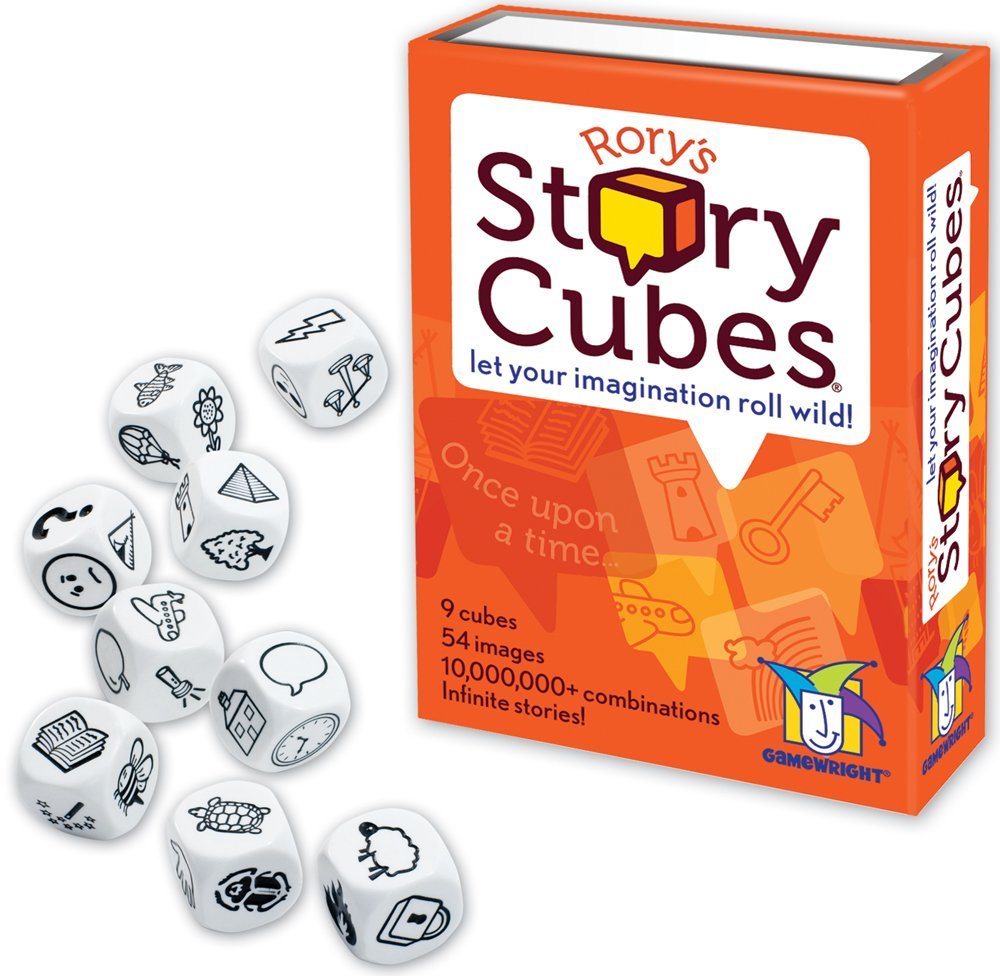
I can’t help it.  Any time I see something that involves building a story, I’m irresistibly drawn to it.  That’s what happened to me a couple of years ago when I was Christmas shopping on Amazon.  (Yes, I do.  You know you do, too.)  Somehow Rory’s Story Cubes popped up somewhere on the screen, and the next thing I knew, I was tossing them in the cart as a stocking stuffer.  Best. Impulse. Purchase. Ever.

71Od9nawZ6L._SL1500_

Have you seen these?  They aren’t new, but I worry that you might have missed them.  Well, okay, I don’t worry.  I hate worrying.  But I really want you to check them out.

See the little dice?  See the pictures on each side of the dice?  You just roll them, look at whatever pictures come up, put them in any order you want, and tell a story with the pictures.  It’s the world’s easiest game.  I mean, my husband would argue that it isn’t a game because no one wins.  Fair point.  But, it is fun.  And my kids will take turns telling stories with it for quite a while.  They even bring it out when their friends are over.  Plus, I’m pretty sure if you thought about it for a while, you could find a way to add points and have a winner.  In fact, I’ll get working on that.  (Not really.  I’ll actually make my seven-year-old work on that.)

Anyway, Rory’s Story Cubes.  They come in three varieties!  Three more reasons to tell a story today!

Nope, I wasn’t paid or given anything to endorse this product.  I just think it’s great.