How to Tell a Story – The Four Step Method

You probably think you aren’t any good at making up stories.  I mean, I hope that isn’t true, but the vast majority of people I talk to say the same things.  “You write stories?  I could never just make up something out of my head like that.”  “I’m not really that creative.  I couldn’t think of anything that my kids would want to listen to.”  “I can draw, but when I try to think of words, my mind just goes blank.”

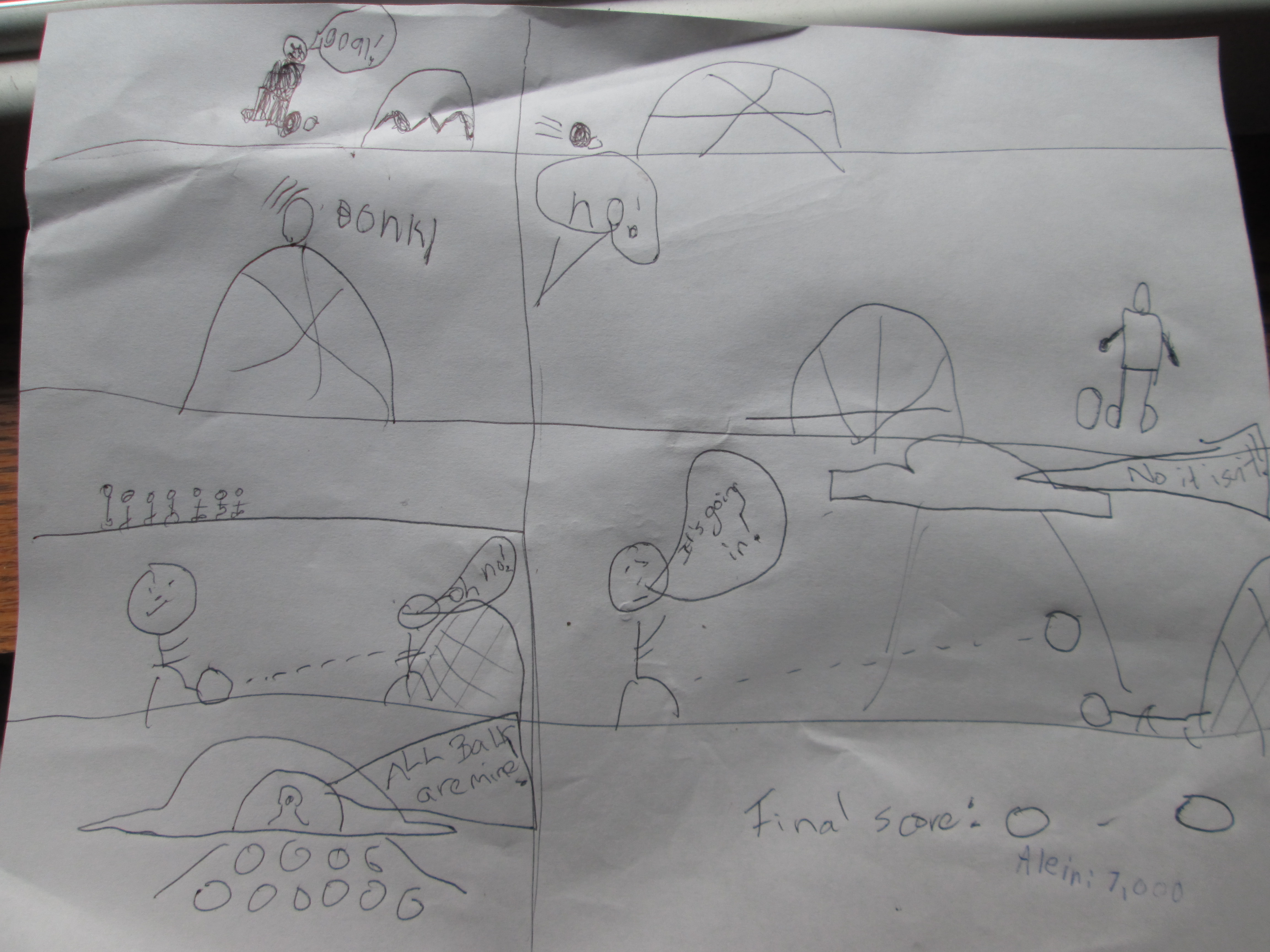
I get it.  I have zero talent in the visual art department, so I mostly say the same things about drawing.  BUT.  I do sometimes scribble things for my kids.  I sit down with them and “paint” awful landscapes.  Yesterday I even sketched out comics with my son to keep them all quiet in church.  We’re talking stick figures here.  I don’t do it a lot because that’s not my thing, but I do care about them appreciating visual art and I do want them to explore their own possible talent.  (I think my son has the makings of a great cartoonist, but then, I’m his mother, what am I going to say?)  So I suck it up, keep it simple, and put something on paper.  I hope maybe along the way I’m also teaching them to be brave and do things even when they aren’t very good at it.

Did I not say stick figures?  Did I not say “zero talent”?  You probably can’t even tell which parts were drawn by the 7-year-old and which were drawn by me.
IMG_0383

I think you should do the same thing with storytelling, and I’m going to tell you exactly how to do it.  (I’m bossy like that.) You should make up stories for your kids.  Not every day.  Maybe not even regularly if that’s not your thing.  But I think you should try it.  I think you should surprise them with a tale from time to time.  Show them that you value stories.  Encourage them by example to try out their own storytelling talents.  Also…trust me on this…it will be fun.  You may be sweating bullets, but you are going to love how entertained they will be.

Because they WILL be entertained.  I’m telling you, especially if your kids are under the age of 8, it takes next to nothing to draw them in.  They will giggle or shiver or hold their breath anxiously at the lamest ofstories.  Even older kids will listen pretty attentively (admittedly while rolling their eyes).  I’ve tried this out on a ton of kids of all personalities.  It works every time.  Just trust me.  I mean, don’t pull them away from their favorite video game or TV show and expect them to be impressed.  But the next time they’re bored in the car or waiting at the doctor’s office, that’s your moment.

Keep it simple.  Keep it fairly short.  Follow these four steps and then when it ends all too soon, ask them to make up one of their own.  You can even walk them through the steps.  Ready?

  1. Think of a character.  It can be anything: an animal, a person, a robot, a monster.  Don’t overthink it.  Just use the first thing that pops into your head (Kangaroo!  Firefighter!  Little girl named Runka!)
  2. Think of the weirdest thing that character could do regularly. This can be anything that person/thing wouldn’t do in the real world.  Again, use the first thing you think of, even if it isn’t exciting.  (A kangaroo that talks!  A firefighter that tap dances through fires!  A little girl named Runka who flies!)
  3. Think of the most obvious problem that weird action could cause.  We’re still going with the first thing you think of, but now you don’t have to think of anything weird.  Just natural consequences.  You’re a parent.  You’re all over these.  (Talking kangaroo gets captured and put on display in a circus.  Tap dancing firefighter trips in a fiery building.  Flying Runka doesn’t know how to land.)
  4. Find the most logical solution to their problem.  The solution can involve other people, or they can save themselves.  They can learn their lesson or keep having the same problem forever.  Whatever comes to you in the moment will work, as long as the problem gets solved in some way.  If you’re stuck, just think about what you would do if you were stuck in that problem.  (Circus kangaroo escapes but can’t stop talking and is in and out of zoos the rest of its life.  Tap dancing firefighter is rescued by his crew and decides to save his tap dancing for the stage instead of fires.  Flying Runka crashes into a tree, which breaks her fall, so she goes around planting trees to land in, so she can fly wherever she wants.)

And just like that, you have a story.  If you feel creative, you can embellish, add details, put in twists and turns.  But if you don’t feel it, or if you are an inherently logic-driven person, no worries.  Only step two requires any creativity, and that’s just basically thinking of what makes sense and then picking the opposite.  You can handle that.  Let me emphasize again, it doesn’t matter if it seems lame to you.  The genius of stories paired with kids’ flexible brains is that they are visualizing it and embellishing it in their own minds without even realizing it.  Which, in addition to meaning it’s more fun in their heads than in yours, basically means you are making them smarter.  (That is based on absolutely no scientific research, but it’s totally true.)

Here’s me making up one with no extra thought at all:

1. George

2. Turns somersaults.

3.  Gets really dizzy.

4.  Goes to the doctor who runs tests and can’t find anything wrong.  Then George does a somersault in the office, and the doctor says, “Hey, maybe don’t that anymore.”  George can’t stop, though, so he staggers through the rest of his life, occasionally rolling over to the amusement of all his friends.

Obviously, that is a super short story, but when you add in some description (How old is George?  How many somersaults?  How dizzy was he?  Dizzy enough to throw up?) it’s pretty complete.  And even if the details aren’t easy for you, you can always get kids to help you.  They like an interactive story.  (One there was a man named George.  What do you think he looked like?  You are right!  Well, George really liked to turn somersaults.  He did it all day long.  How many somersaults do you think he can do in one day?)

Try it!  (Please?)  You may just impress your kids a little.  You may just impress yourself a little.

I’ve got a couple of other story methods for you try out.  I’ll try to get them out to you soon.  In the mean time, here’s where the four step method originated.

And you really ought to read about HOW TO TURN ORDINARY STORIES INTO JAW DROPPING THRILL RIDES.


Why I Tell Stories

mesuitcase

Once upon a time there was a girl who was in a hurry to grow up.  She wanted to be independent.  She wanted to be and go and do.  And most of all, she wanted people to take her seriously.  Naturally, she did grow up, as you do.  She went to college, traveled, got married, got a job, and was as grown up as she had imagined being.  She was surprised at what she discovered in grown up life.  She found that being independent was only fun with other people around to share it.  She found that, very like childhood, what she wanted to be was happy, where she wanted to go was a place in her imagination, and what she wanted to do was share a Slurpee with her best friend.  In the end, she even found that she would like people to take her a little less seriously.  That last discovery gave her the freedom to say out loud some of the things she had been thinking all her life, to make believe with other people and not just inside her head.  Which was, of course, the moment she was truly grown up.

1yochristmas

Once upon a time there was a brand new mother.  Her little tiny baby was precious and wonderful and wanted to be held and talked to every moment of every day.  This mommy loved her baby, but day after day the baby just lay there, looking extremely cute but not actually doing anything interesting.  The baby grew.  The mommy’s love grew, too, and so did her boredom.  The baby wanted her mommy’s attention, so there were very exciting breaks.  The baby wanted to play with little toys, which she pushed back and forth on the floor in the world’s most boring way.  The baby’s eyes sparkled, but her conversation skills were distinctly lacking.  The mommy began to feel that she was going to lose her mind with all this adorable tedium.  Then she discovered that stories could save her.  She learned to read a book with one hand while building a block tower with the other hand.  She learned how to read a book while pushing a stroller.  Then another baby came along, and she learned how to read a book while feeding a toddler with one hand and bouncing a baby in a chair with her foot.  Then when things got really crazy, she learned how to think out stories in great detail so that her mind could roam free in open spaces while her hands changed diapers and pushed swings and folded laundry.  Which is how the endless round of duties began to feel less like serving a life sentence and more like truly having a life.

IMG_4727

Once upon a time there was a mother with three beautiful, intelligent, charming, headstrong, emotional, intense and overwhelming children.  When they were still quite little, her life was full of the drama and misadventures that only extraordinary little people can bring.  A simple drive to the store would result in a (not so) well-reasoned argument about why they should just keep going the two hours to Grandma’s house.  The time it took to make a box of macaroni and cheese was enough for a toddler to grow monkey arms and hang around the knees like an inconveniently-placed, shrieking backpack.  And God forbid simple grooming habits need to be cared for, such a a bath or the removal of tangles.  Life with the three children challenged every part of of the mother’s being.  In desperation, she turned to the thing that had helped her through all the worst moments of her life: stories.  When a comb was in hand, a story could be the difference between a little girl terrifying the neighbors with her screams and the occasional, inevitable, moan or yelp of pain.  On car rides of all lengths, a story could be the difference between a string of unending questions and a string of unending giggles.  And on long afternoons when older siblings had at last gone off to school, a story could be a difference between a fifteenth request for craft time and a snuggle on the couch.  So the stories grew, as stories do, and took on a life of their own, and soon the three extraordinary children began to invent their own extraordinary stories.  Which, of course, gave the mommy a break, and also delighted every part of her being.

Behind the Curtain

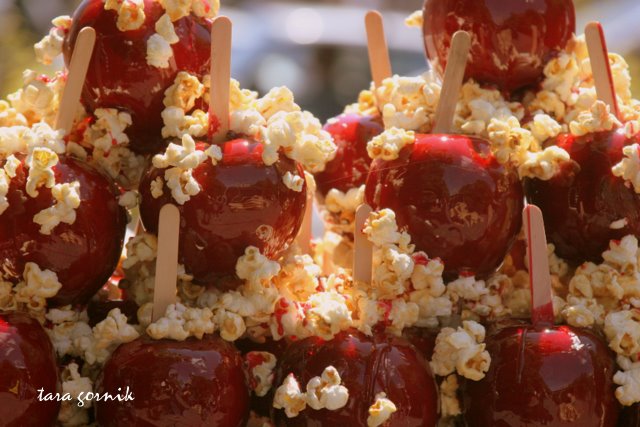
My kids and I are going to write a story about this picture. This is a challenge I’m hoping to do every week with a different picture. This week’s picture is from my good friend Tara over at The View Finder. She’ll probably be giving me a lot of them. I love the possibilities in pictures. I can’t take good ones to save my life, but I still love them. I won’t put you through the long (boring?) process every week, but this time I thought I’d get my kids in on the action and record our brainstorming session. Final story to come tomorrow.

What could these be?

cake
apples with popcorn
bombs disguised as apples
popsicles
cherries in the snow
little children that a witch changed into apples

Who could have put them there?
God
We did
Gypsies
a witch
a princess
a prince
dinosaur
an alligator

What could someone do with them?
eat them
play with the sticks
throw them at someone
use them to stick to the wall and climb it
hit people over the head with them
feed them to someone else

What happens if you eat them?
you turn into an apple
you turn into a popcorn
you turn into popsicle stick
you turn into cherries in the snow
you die
you get sick
you get mad
you get sad
you turn red
you become invisible
you become invincible
you can fly
you can run really slow, then really fast, over and over

I have about four possible stories brewing in brain from all these ideas.  We’ll see which one comes out when I sit down to write tonight.

Time Out Tuesday – Inspirations

I was going to talk more about what makes my favorites…you know, my favorites, but as it happens, I’m flying to the U.S. in two days with my whole family for a five week visit, so right now my mind is jumping from one thing to the next like a jackrabbit on crack. Pensive and analytical aren’t going to happen tonight. Instead, I’m just going to let my mind do its thing.

Which brings us to inspirations. Where do the story ideas come from? Anywhere and everywhere the jackrabbit lands. I have about a billion little notebooks that I use to make lists and jot notes.  Whenever and wherever an idea comes, there’s always a little book nearby to jot it down.  I mean, it will be right between the To Do in the Morning List, the Don’t Forget to Pack This List, and the Life Goals List, but at least it’s there when I need it.

Here’s a list of inspirations. (I love lists.)

In no particular order…

Photographs. Especially ones that evoke a strong feeling. To me, strong feelings go along with stories, so I start to wonder what the story is. A while back The Pioneer Woman did a photo contest about landscapes. Two of my stories were inspired by pictures I saw there. This one was just begging for a story.  And the perspective on this one made me think of someone very small looking up at the unexpectedly tall tulips.

My son. He says the weirdest and funniest things. Like about monsters fighting houses. Or a prince trying to save a princess when he doesn’t know which one she is. These things just come out in a stream of other make believe and chatter, and sometimes my brain latches on to one and goes crazy. Of course, other times my tired brain just flops around and drowns in the flood. (See how it was a rabbit and now it’s some kind of pathetic fish? I see no reason to stick to just one metaphor.)

Advertisements. My daughter loves to cut pictures out of old magazines. Then she gives them as presents to everyone in the family. One day she presented me with one that featured a fine old bottle of whiskey in a stream of water. Don’t ask me. But I did get to thinking about how intriguing it is to find a bottle in a body of water and what could be inside.

Words. The Nerd Mafia are my new heroes. Certain words just make me think of certain kinds of people. And once you have an interesting person, there’s always a story of some kind nearby.

Those little linky things. Nothing gives you writing ideas like someone saying, “Write about this.”   Thanks, Mama Kat.  Plus now I keep finding more and more linky things.  I don’t think I can ever be a consistent weekly participant in any of them, mostly because the words “consistent” and “weekly” scare me to death, but I do think they’re fun, and I’ll take inspiration from wherever I can get it.  Plus it actually gets me out into the world of other bloggers, reading and exploring (mostly with time I don’t really have).  I feel like a small mouse poking my nose into a wide open candy store.  I’m out of place, but I certainly don’t plan to just go away.  Hey, I think there might be a story here…

Okay, we’ve now run the gamut from rabbit to fish to mouse.  That’s the signal that it’s time for me to get back to pouring over my To Do lists for the next two days.  I always feel that if I rewrite and reread and reorganize the list, it’s almost like I’m actually doing the things on it.  Isn’t it great when you can feel productive while sitting on your couch watching Sherlock Holmes on Pay Per View?

Robert Downey, Jr…  That’s going to take a whole other post.

Time Out Tuesday – Stuff I Love

I’ve been thinking this week about stories I love. You know that moment when you are reading or watching along and then it’s like you just walked off a drop off on the water? Boom! Suddenly your head is under and you are in another world. That moment is one of my favorite things in life. I don’t particularly want to scientifically analyze that because it’s magic, and magic can’t be analyzed. But since I like to reread and rewatch and relive my favorite stories, I’m thinking back and trying to remember that point of no return. Here’s what I’ve come up with:

1. It’s the moment when you feel an authentic connection between two characters.

For me that’s the gateway in The Lion, The Witch, and Wardrobe. The first chapter is completely dull. Then Lucy finds the wardrobe and the magical world on the other side, but even that isn’t quite it. It’s when she meets Mr. Tumnus and he’s just as scared of her as she is of him that you know this is going to be something special.

The connection doesn’t have to be that positive, either. I was hooked on Pride and Prejudice from the very first chapter where we see Mr. and Mrs. Bennet interacting. Their relationship is so dysfunctional and real and witty and entertaining that I knew I wanted to keep reading as fast as I could. And that was true even the first time I read it, while I was hiding out and eating my lunch in the library in high school. But that’s another story. The point is that Jane Austen is a genius. Oh, and something about connection. Where was I?

This happened to us the other day when we finally watched the movie version of The Time Traveler’s Wife. I’d read the book and loved it, but for my husband it was the first time. About 10 minutes in, Henry and Claire meet, and it’s just so warm between them, even though they are strangers (sort of…you know), that my husband immediately said, “I’m going to like this movie.” And he was right. It was lovely.

There are so many more. You know that moment in Stranger Than Fiction when you realize he’s going to have an actual relationship with this voice he’s hearing? Brilliant. Or The Royal Tenenbaums when Margot steps off the Green Line bus and the whole movie clicks into place. I don’t even have to say anything about that because you already know exactly what I mean. There’s just something about the human connection that casts a spell on us all.

2. It’s the moment when pain and beauty intersect. Because life is pain, and anyone who tells you otherwise is selling something. (Everything I know I learned from The Princess Bride.) But life is also beautiful…if you can learn to live with the pain. As soon as I can see that the story is going to be honest about all that, I’m in.

There’s this wonderful series of books called the Sevenwaters Trilogy by Juliet Marillier. Each book has a fairly slow start but the payoff is totally worth it. In the first book, Daughter of the Forest, I was finding it hard to totally connect until the young heroine is brought face to face with harsh reality in the form of a young man her father’s men had tortured. Don’t get me wrong. I’m not into super dark stuff. I actually sort of avoid it. But as Sorcha works make things come out right and true while going through one immensely painful thing after another, it’s riveting. It makes me want to be a better person. And that’s what the best stories should do.

Am I getting a little too earnest? Because I hate getting all intense, but stories do funny things to me. Anyway. This mix of pain and beauty (which is another word for truth) is what I love about the best super hero stories, too. This is what Batman Begins and The Dark Knight have that none of the other Batman movies had. And this is what the original Watchmen comic had that the movie couldn’t quite achieve.

It’s there is nearly all of my favorite stories: The Count of Monte Cristo, Ender’s Game, even Little House on the Prairie.

This is already way too long for my non-fiction attention span, but I think I’ll have more on this topic next Tuesday. I’m kind of into it. I love thinking about the really good stuff.

How about you? What really gets you in a story? Which ones grabbed on and didn’t let go? What are the moments that will be with you forever?

Time out Tuesday

That’s right, I invented my own alliterative meme just because I felt like talking about storytelling instead of actually telling stories.  Only every once in a while.  Like, maybe, once a week.  On, say, Tuesdays.  Tomorrow we’ll be back to the tales, I promise.

For today, I present to you:  HOW TO TURN ORDINARY STORIES INTO JAW DROPPING THRILL RIDES.  (Or more accurately: how to hold your kid’s attention for three to five minutes.  But I think my title is much more catchy.)
This is where I make the grandiose claim that no matter who you are, no matter where you are, no matter how boring the story, you can make it into something your kids will want to listen to.  It’s all in how you tell it.

Of course, like all grandiose claims, this one isn’t strictly true.  For example, I don’t recommend trying to tell your kids the story of how you buttered your toast while you are walking the magical streets of Disney World.  I’m guessing that story will be better told on a rainy day when your television has exploded.  But still…

1.  Make it about people they know, preferably themselves.  If you’re telling a story from your own childhood, you’re already halfway there.  But if you are telling a story about a princess trapped in a castle or a cowboy riding the range, name the main characters after your kids.  We even used to tell the story of “Ellielocks and the three bears” around our house.  It was a favorite.  I could get all philosophical and talk about how we’re all narcissistic at heart, or I could get all pedagogical and talk about how the use of their name triggers their imagination to place themselves in the story.  But that sounds like too much work, so instead I’ll pull a mom and say, “Trust me.  They’ll eat it up.”  The younger the kid, the more they will love this one.

2.  Use a goofy voice.  I don’t care how atrocious your British accent is.  Your kids don’t care either.  Try it out on a story.  I promise it will make it seem scarier…or funnier…or at least weirder.  Okay, so your spouse will probably laugh at you.  You might want to save that one for when you’re alone with the kids.  But you can give characters in stories any old voice you want.  Telling a story about your old math teacher?  Give her a witch’s voice.  Telling a story about a talking dog?  Make him French.  And do you think you are terrible at using different voices?  Join the club.  If you can’t do an accent to save your life, you can still try making a character talk really slow or really fast, really high-pitched or really low.  It works just as well, and anyone can do it.  Well, anyone who isn’t afraid to sound silly.  And if you are afraid to sound silly, you’d probably better stop reading this right now.

3.  Ask questions.  Let the kids get involved in the story.  Sometimes they are just questions to see if they understand.  “Once upon a time there was a heliotrope.  Do you know what a heliotrope is?  Me either.  Let’s Google it.”  Sometimes they are questions to get them guessing.  “And then the monster came in and found the girl, and what do you think he did to her?  No, he didn’t eat her.  He TICKLED her!”   Some questions are just for interaction.  “The only food he had to eat was dry, moldy bread.  Do you like dry, moldy bread?  If that was all you had to eat, what would you do?”  Questions are particularly good for stories the kids have already heard a thousand times.  “Wait, where was Little Red Riding Hood going?  Her grandmother’s house?  Why would she want to go there?  Was she hoping to get eaten by a wolf?”

4.  Move.  Shout.  Be Alive.  You know what I mean.  You don’t want to do it when you’re tired (which, let’s face it, is all the time), but it works every time.  If someone is going to jump out and yell, “Boo!”  You’ve got to jump.   You’ve got to yell.  If a bee is dive bombing you, swat it away, for goodness sake.  If you broke the chair because you’ve been eating too much porridge, have the grace to look surprised and a little ashamed.  If you can fall on the floor, all the better.   It’s actually pretty fun.  Storytelling, like so many great parenting things, can be a chance to be a kid again.

5. Break out the sound effects. This one pretty much goes along with #4, but it takes slightly less energy. Nothing makes their eyes go wide like someone’s footsteps on the stairs “creak…creak…creak” and the door slowly opening “squeeeeaaaak.” And let me tell you, my sound effects are laughable…and not in a good way. But my 3- and 5-year-old have never complained.

6. Never underestimate the usefulness of the dramatic pause. When their attention starts to waver, spice things up with a little silence. For example, in your toast buttering story. Right about the part when you put in on the plate and get the butter out of the fridge, things start to get a little dull. That’s when a pause can be the most effective. “I got the butter out of the fridge…(long pause)…and I opened the lid…(long pause accompanied by a look of suppressed excitement)…and what do you think I saw? (long pause…by now they are expecting alien symbols to be carved into the butter or a perhaps a severed finger) I…saw…that someone…SOMEONE…had used all but a tiny bit of the butter!” I know…the payoff is totally not there. But I’m telling you, the dramatic pause has given you three distinct advantages: 1)They were listening for those 45 seconds, 2)That tiny bit of boring butter is still about 100 times more interesting than it was before, and 3) You bought yourself some time to think up an alternate and maybe more interesting ending. Because maybe that dramatic pause didn’t just inspire your kids. Maybe it inspired you. Maybe on the spur of the moment, with the full knowledge of how boring your story is, you decided that what you really saw that morning was a big bite out of the butter and that your house is likely infested with butter eating monsters. Don’t underestimate yourself. It could happen. I can’t possibly be the only one…

So what do you think? Anyone else have some good storytelling tips to help us out? Shining examples of storytelling success? Tales of storytelling woe?