Perspective

cloudtops

Under the clover the whole world is green
From the ocean the ground seems an unsteady thing
In a tunnel, a flashlight’s unbearably bright
After lifting a whale, a cow feels pretty light

To an inchworm a mouse is enormously tall
From a mountaintop all of the world’s just for dolls
On top of the clouds, rainy days are sunshine
With you here, out of reach turns to already mine


Get Inspired: Photo Magic

ghostfish
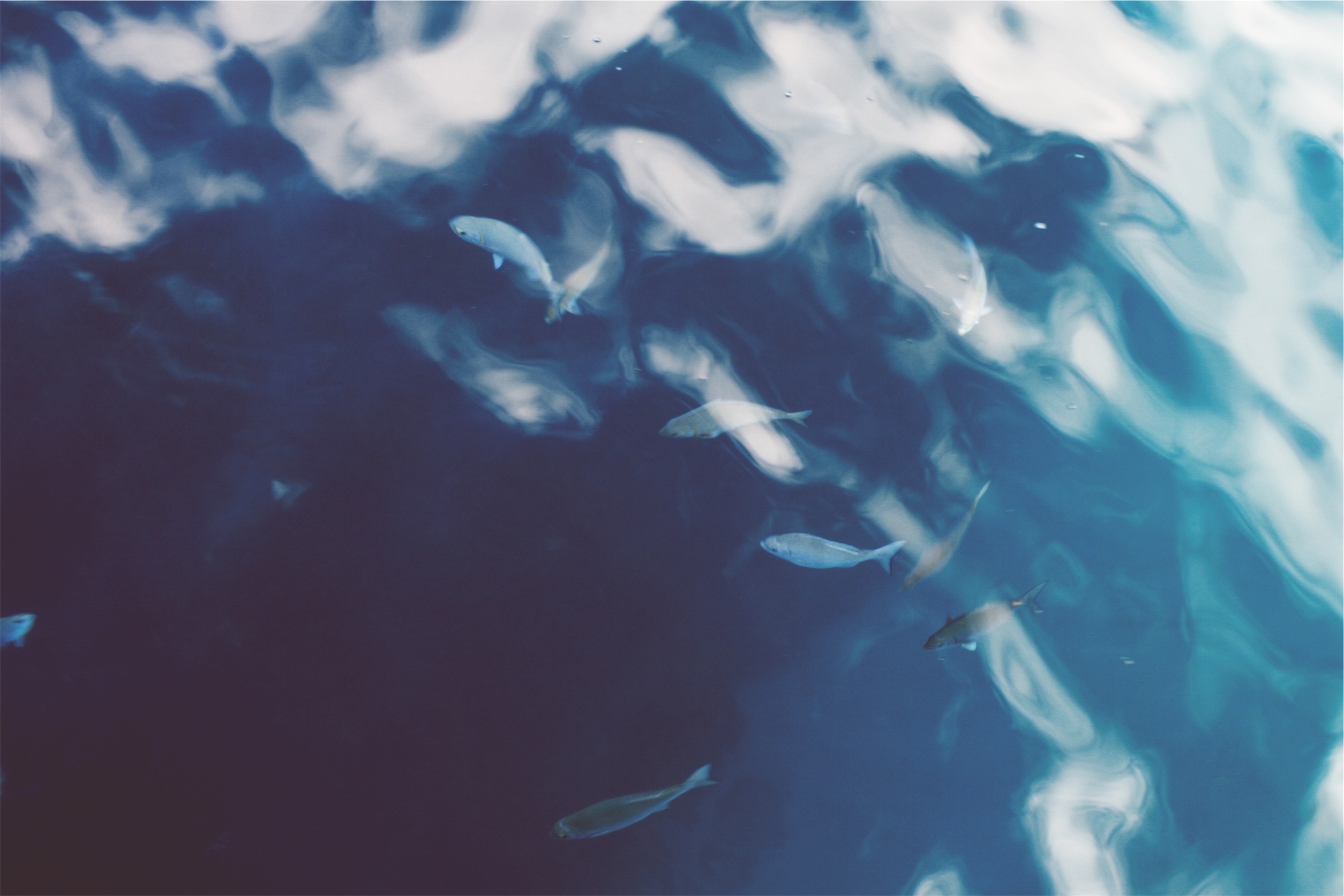
This isn’t my photo, but I call it “ghost fish.” Somewhere on the edge of my imagination, ghost fish swim through a very creepy story.

February. Hand down the worst month of the year, am I right? Far enough from Christmas that we’ve forgotten it, far enough from spring that we can’t see it yet. Cold and gray and what do you mean I have to buy three sets of perfect Valentines and hang paper hearts everywhere?

We’re on the hunt for inspiration. Something to make us glow from the inside and remind us that the world is fascinating and that there’s so much out there to counterbalance the greeting cards.  We’ve found some inspiration in books. We’ve found some from our kids.  We’ve found some in our online community. We’ve found some in history. Today we’re going to feast our eyes and look at life through someone else’s camera lense.

mistymountains
Is there anything more mysterious that mist? It’s been used to the point of cliche, but there is still so much hidden in there to be discovered…

It’s no secret that I get a lot of inspiration from creative images.  I have no visual artistic skills of any kind, but I endlessly troll the internet for photos that trigger something inside me.  I keep a Pinterest page just for pictures that made me think, “I’m going to write a story about this.” I visit it often. If you read here regularly, you might find the roots of some of your favorite stories there.  I also keep this Tumblr purely for my own pleasure. When I get into that certain place where nothing fits together right and I can’t put my finger on the problem, I just scroll through the images and feel the internal sigh of relief.

I don’t have permission to post all of my favorites here, but follow me around the net a while, and take a look at the magic that’s being created.  You won’t be sorry.

Lissy Elle. She’s one of the first photographers I ever followed. Images like this one (and this one) hooked me forever.  Her Flickr feed ranges from the dark and bizarre to the whimsical and magical, but they all capture a very specific emotion. Love her.

Ashley Lebedev.  I first found this photo and was enchanted.  That took me to her very interesting Flickr feed. Many of these are more staged than I like, but there are a few complete gems.

Along those same lines is this photo. It’s one of my favorites ever, and the artist, Lione Bakker, creates portaits that have such a luminous quality.

rustycar
Someday I’m going to explore a post-apocalyptic world, and when I do, I’ll find out the story behind this.

I also love anything and everything that uses perspective creatively. Perspective is one of the most interesting things in life.  The more we examine it, the better.

That said, this one makes me feel a little sick.

I know it’s all a trick, but I still find most of these resonant with stories I want to tell.

And my all-time favorite (because I want to tame the moon).

cloudtops
There’s a whole world above the clouds. If we could walk there, I wonder what we would find?

And finally, the wonderful way that photos can tell real life stories. So many people have done this well over the years, but Angelo Merendino is my new favorite.  This series brought me to tears this week. I don’t like to be brought to tears, but this was worth it.

Did you click the links? Did you soak it all in?

February doesn’t seem so bad after all, does it?

On the End of the Pier

pier

Sarah didn’t like many things.   Books took too long to read. Movies were all either boring or ridiculous. Running was way too much effort. Swimming was far too wet. Only Rachmaninoff’s Symphony No. 2, played loudly on her headphones, made her feel alive.

Sarah didn’t like many people. Her mother was too exhausted to be interesting. Her little brother was too energetic to be tolerated. Her step-father was too rude to be listened to. Her teacher was too sweet to be believed. Only her best friend, Frankie, made her feel understood.

Sarah didn’t like many places. Her bedroom was narrow and confining. The bus stop had oil stains and smelled of exhaust. The park was too full of sad squeaking swing sets. The beach was too full of sad, squawking people. Only the spot on the end of the pier made her feel free.

Sarah was in that spot today, earbuds in her ears, Rachmaninoff in her head, butt seated on hard cement, legs dangling over the end of the pier, cheek pressed against the wooden railing, eyes on the endlessly rippling horizon. She was, for just one moment, perfectly happy.

Then the song ended, and she remembered.

Frankie the brilliant. Frankie the weird. Frankie the genius of comedy who could make Sarah laugh so hard milk came out her nose. Frankie the loyal. Frankie the kind. Frankie was moving to Iowa.

Iowa was so far way Sarah wasn’t sure it was real. Lots of corn, Frankie said. Not much in the way of hills. No ocean at all. Sarah couldn’t even imagine it.

Symphony No. 2 started up again, but now Sarah wasn’t listening. She was trying without success to picture a horizon filled with cornstalks and the sixth grade filled with girls who weren’t Frankie, while she watched the progress of the giant sea turtle that was swimming toward the pier.

There was a giant sea turtle swimming toward the pier.

Visions of Frankie drowning in waves of grain disappeared in a flash. Rachmaninoff swelled as the turtle raised its head and looked right at Sarah. He was just below her now, patiently treading water.

“I don’t like to get wet,” Sarah said.

The turtle was unmoved.

“I have my iPod with me,” Sarah said.

The turtle didn’t even blink.

“It’s not safe to climb down from this spot,” Sarah said.

The turtle waited.

Sarah took out her earbuds and set her iPod on the cement. Rachmaninoff was silenced, but her heart still beat the strong, steady rhythm of Symphony No. 2.

Sarah left her spot on the end of the pier and climbed down the wooden struts toward the cold water. She had never been to this place under the pier, but the rippling horizon remained in its place.

The turtle met Sarah where the water lapped against the pier.  It turned its back to her and she climbed on. Quickly and quietly the turtle took her out to sea.

Sarah knew that she should have felt afraid, but she didn’t. She felt alive.

The water stretched out on every side. The shore was just a smudge on the horizon. It was so very far away. Sarah lay her head on the turtle’s ridged shell and cried so hard her whole head ached. Then she told the turtle all about Iowa.

Sarah knew she should have felt ridiculous, but she didn’t. She felt understood.

The sun was sinking into the water, setting each ripple on fire as it slowly disappeared. The turtle turned back and carried Sarah back through a golden wonderland to the real world, to solid ground, to the continent that would soon swallow Frankie whole.  Sarah clung to the wooden pier as the turtle swam away.

Sarah knew that she should have felt abandoned, but she didn’t. She felt free.

Sarah climbed up to where Rachmaninoff waited in that perfect spot at the end of the pier.  She put the earbuds in and slowly walked down the pier, in the general direction of a sixth grade classroom that had no Frankie in it and of a state called Iowa, which Sarah still couldn’t imagine but now felt sure was real.

Undefined Truth

Quotation-Hannah-Arendt-meaning-Meetville-Quotes-18116

Let me tell you a story.

Hannah Arendt was born in 1906 in Germany to a non-religious Jewish family.  She grew up, went to the university and studied philosophy, but was prevented from becoming a teacher because she wasn’t allowed as a Jew to complete her teaching prerequisites.  She spent time researching anti-Semitism before being arrested by the Gestapo in 1933.  She was only in prison briefly and then left the country for France.  At the beginning of the war, she fled with her husband and mother to the United States, having been given illegal papers by an American diplomat who aided Jewish refugees.  After the war, she returned to Germany and worked for a Zionist organization that rescued children and settled them in Palestine.  She began to write books.  She became well-known as a philosopher, though she didn’t like being called that because she said philosophy was concerned with individual man.  She considered herself a political theorist because she focused on the fact that “men, not Man, live on the earth and inhabit the world.”  She became a college professor and lecturer (the first female lecturer at Princeton, in fact.)  Hannah died in New York in 1975.

The man who helped Hannah and her family get to the U.S. was named Hiram Bingham.

Hiram Bingham was born in 1903 to a distinguished Connecticut Christian family.  He graduated from Yale in 1925.  Bingham’s career in the foreign service took him to Japan, China, Poland, and England before landing him in Marseilles, France in 1939.  When Hitler invaded in 1940, the French government put foreign refugees into internment camps and the U.S. government discouraged diplomats from helping these refugees.  Bingham didn’t care.  He cooperated with rescue workers to help over 2500 Jews flee from France as the Nazi’s approached.  He aided the emigration of Marc Chagall, Hannah Arendt, and novelist Lion Feuchtwanger, even sheltering Feuchtwanger in his house for a while after aiding in his escape from the internment camp.  As a consequence of all this, the US government pulled Bingham from France and transferred him to Portugal and then to Argentina, where he proceeded to help track Nazi war criminals in South America.  Naturally, he was passed over for promotion, and resigned from the foreign service in 1945.

Lion Feuchtwanger was born in Germany in 1884.  He fought briefly in World War I, but was released for health reasons. He was a playwright and later a novelist who was very influential in the life of famous playwright Bertolt Brecht. Feuchtwanger was among the first to recognize and expose the evils of the Nazi party.  His Conversations with a Wandering Jew was published in 1920 and already described the anti-Semitic fervor that would overtake his country with eery accuracy.  You can read more about the story of his persecution by the Nazi party and the many, many people who helped him escape here.

You can read about Bertold Brecht here.

You can read about philanthropist Martha Sharp, who worked with Hiram Bingham, here.

You can find your own meaning in these true stories wherever you want.

(All this information comes from the hallowed lines of Wikipedia. Yep, that's research.)


Unknown

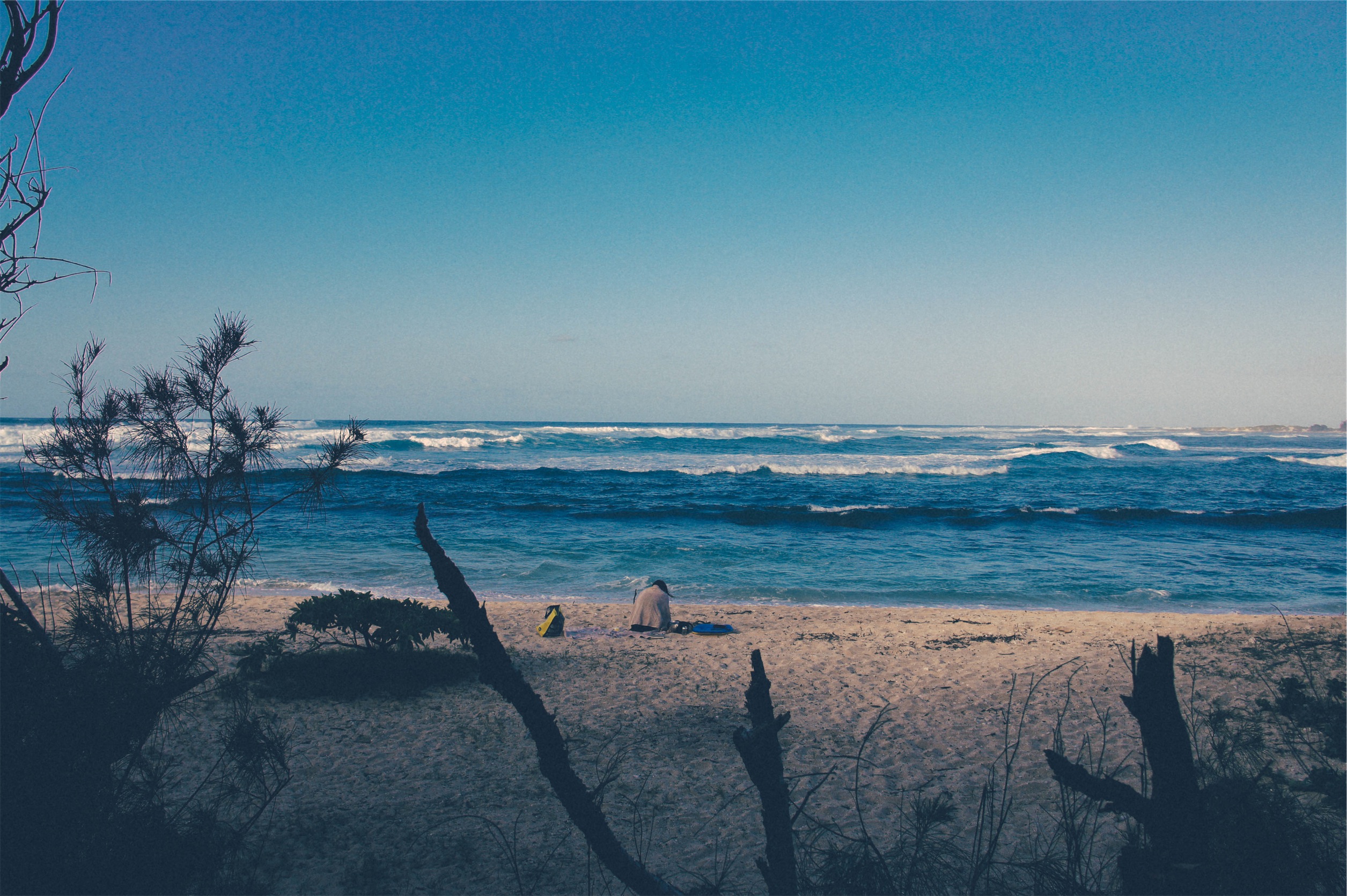
beach

I’m older than I used to be
I’ve learned a few things, too
Some questions have been answered
(I know why the sky is blue)

Every day come new discoveries
Always more than I had planned
But still some mysteries elude me
Things I’ll never understand

Like why the sand feels so amazing
On my toes down by the shore
But it’s the worst thing in creation
Under my feet on my own floor

Or why my favorite cozy sweater
Grows those little fuzzy balls
(Are there tiny elves that make them?
Are they living in my walls?)

And why do some people have everything
And others not enough?
And who invented all this junk mail?
And how did badgers get so tough?

And will we ever build a moon base?
And does a mountain know it’s big?
And how does hope make so much difference?
And will I ever own a pig?

And why on earth do you still love me
When I pass my days this way?
I know I’ll never comprehend it
And yet, you do, so it’s okay

Cause that’s the thing about not knowing
In a way, it’s the best part
What my brain can’t lay out neatly
Makes happy jumbles in my heart

It’s Not Stuff; It’s Stories

My parents have moved to town!  It’s a long, whirlwind story, but the happy ending is that this week they moved into a house less than ten minutes from ours, and now my children have both sets of grandparents living close.

If that sort of thing seems normal to you, then you probably can’t understand how this feels to me.  Three quick pieces of information for important context: 1. I grew up moving every year or two and never lived in the same town as my own grandparents, and 2. I went to college halfway across the country from home and then married someone local, and 3. We proceeded to move to Argentina, where we lived for nearly a decade and where I birthed two of our three children.

Needless to say, I never, ever envisioned a life in which my children would grow up around all of their grandparents. Sometimes, life just gives you those unexpected bonuses. I couldn’t be more grateful.

Cut to this weekend, to my kids helping Gramma unpack in her new house.  I was upstairs moving boxes of books to and fro, and when I came down, there were all three kids on the floor with my mom, beautiful tea cups and glassware on every available surface, having the time of their lives.

IMG_2207

“Tell your mom what you just told me,” Gramma said to my son.

In classic kid fashion, he was too squirmy to respond, so it was up to Gramma.

“He just said, “Hey, this isn’t really about the stuff.  This is really about the stories.”

IMG_2209

These are the moments you can’t plan for.  But oh, when they come.

Every tea cup has a story.  Every nick-knack is a reminder of someone, of something, of some time.

Each little treasure they unwrapped was a double treasure, an object of beauty and also a little glimpse into their Gramma’s long and fascinating life.  (Not so very long, Mom, only long to them.)

IMG_2213

These stories are all around us every day.  The things that fill our homes, that sit on our shelves, that hang on our walls.  They are artifacts, stories just waiting to be told.

When was the last time you let your kids in on their secrets?

He’s My Best Friend And He’s Also A Bear

Frankie Orzo was a strange boy and he came from an equally strange family.  He spent a lot of time by himself.  Too much time, his teachers all agreed, but his Great-Aunt Lela, who was his legal guardian, wasn’t concerned.

“Boys have to go their own way,” she said, placidly rocking in the old wooden chair she kept on the porch for just that purpose.

She only said that because she hadn’t yet realized what way Frankie was going.

Frankie’s grown-up cousin, Louise, who also lived with Great-Aunt Lela, wasn’t concerned, either, but that was because she was too busy with her bees.  Louse was a bee-keeper and had fourteen hives out behind the house.  This was one of the chief reasons no one ever came to the house, which of course, just left Frankie with even more time by himself.

A lot of boys would have bored living with two old women and a bunch of bees, but not Frankie.  A lot of boys would have been lonely with nothing to do but roam the woods behind the house after homework was finished, but not Frankie.  Frankie was never bored or lonely.  That’s because Frankie had a secret.

Frankie’s secret went unnoticed for a long time, but nothing stays secret forever, and eventually hints began to appear.

One day on the playground the Harrison brothers were bullying Frankie as usual when suddenly, Frankie reached his arms out to the biggest Harrison brother and wrestled him to the ground.  No one was hurt, but the Harrison boys cried anyway, of course, and Frankie was taken to the office and questioned.

“Where did you learn to wrestle like that?” Principal Mills asked.

“My friend Oswald taught me,” Frankie said.

As no one had been hurt and wrestling was not technically the same as fighting, Frankie was sent back to class with a warning to be more careful.  Principal Mills checked the school records and verified that there was no student named Oswald, but he was a busy man and couldn’t give it much more thought than that.

A week later, Louse came out the back door to find Frankie with his arm inside one of the bee-hives.  While she watched, she carefully pulled his hand out, dripping with honey, and walked away without a sting.

“Where did you learn to handle bees like that?” Louse asked, when she was done telling Frankie off for messing with her hives.

“My friend Oswald taught me,” Frankie said.

“Who is Oswald?” Louse asked, wondering if there was another bee-keeper in town.

“He’s my best friend,” Frankie said, and Great-Aunt Lela rang the dinner bell, cutting off all further conversation.

Two days later, as Frankie was walking home from school, Mrs. Hanson’s dog dug under the fence and confronted Frankie on the street.  Frankie was pale as a sheet, but he stood his ground and as the dog approached, Frankie growled so fiercely that Ripper turned tail and scuttled back under the fence.

Mrs. Hanson, who only saw the last part of this as she pulled into her driveway, was alarmed.

“Where did you learn to growl like that?” she asked Frankie.

“My friend Oswald taught me,” Frankie said.

“What kind of friend would teach a boy to growl?”

“He’s my best friend, and he’s also a bear,” Frankie said.

“Well, I don’t know who this Bear family is, but your grandmother ought to be warned that you are associating with low types,” Mrs. Hanson huffed, and she trotted straight inside to make the call before Frankie could say that Lela was actually his Great-Aunt.

When Frankie got home, Great-Aunt Lela was still rocking placidly on the porch.  She didn’t get up or yell or do anything other grown-ups might have done, but she did say that Frankie was to invite his friend Oswald to dinner, the next night, no excuses.

Frankie did not think this was a good idea, but for all her placid rocking, when Great-aunt Lela made her mind up about something there was no changing it.

The next night, when Great-aunt Lela rang the dinner bell, Frankie came into the yard right on time.  Oswald was just behind him.

Louise screamed.  Great-aunt Lela dropped her bell.

“What is that?” Louse yelled.

“This is Oswald,” Frankie said. “He’s my best friend and he’s also a bear.”

The big black bear nodded over Frankie’s head in a friendly way and tried not to stare longingly at the bee-hives.

“He’s an actual bear,” Great-aunt Lela stated the obvious.

“And an actual friend,” nodded Frankie.

Great-aunt Lela sank into her chair, but she did not rock, placidly or otherwise.

Frankie was a very strange boy, but he was still a boy.  It was dinner time and he was hungry.

“Is it time to eat?” he asked.

Louise stared.

Great-aunt Lela sighed a very, very long sigh.  Then her chair rocked just a little.

“Better bring the dinner out here on the porch, Louise,” she said.

Louise was too stunned not to obey.

Eating on the front porch with a bear as your guest is a very strange thing to do.  Finding that you rather enjoy it is even stranger.

Fortunately, Frankie Orzo had always been a strange boy and he came from an equally strange family.

 

Some Golden Inspiration

Because January is exactly like this, we’re on the hunt for inspiration these days.  I’m not feeling quite as earnest as I was last Monday, so let’s just float around the internet and stare at beautiful and interesting things that might inspire us to create.

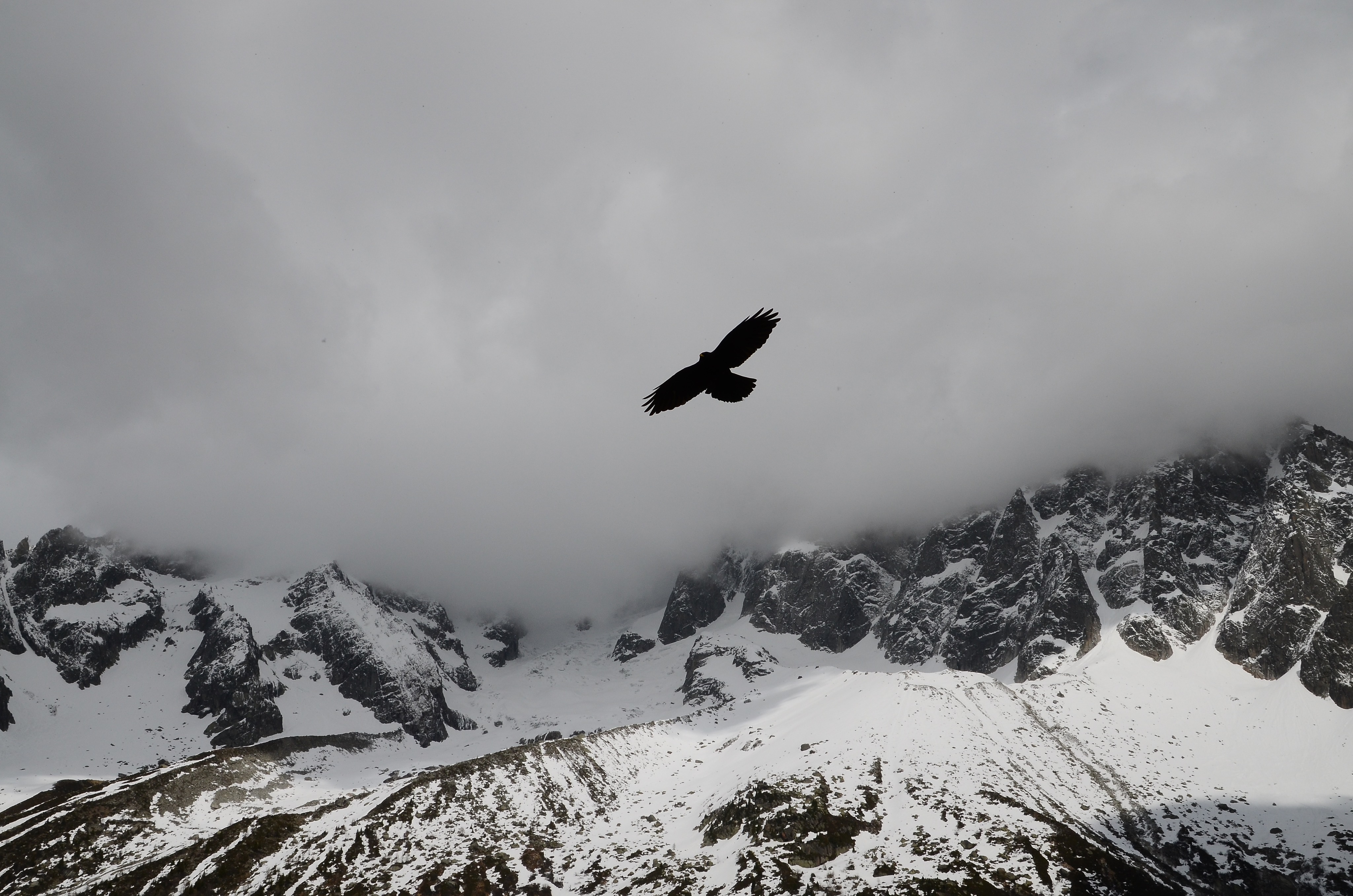
eagle

Ready?  Set?  Go:

  •  This wind map is mesmerizing, and I can’t help but feel that there are endless story possibilities here.  I’m picturing things floating on those winds.  I’m picturing the air from our neighbors blowing over us.  I’m picturing the endless motion of the world.
  • Just found this wonderful site with beautiful high res pictures offered up for free download.  This is something I can get behind.  Pictures inspire me, but I’m useless at creating my own.  Check out this one.  The stars, the water, the lonely house.  Oh, the possibilities.
  • Humor as inspiration.  I’ve been following these for a while, but here they are all in one place.  Warning:  Not safe for children!  But this is a whole new way for art to inspire us.  A way I can totally get behind.
  • Language as inspiration.  I love, love, love these concepts.  Especially hygge.  And I love all those words that exist in other languages and can’t really be translated into our own.  Language and culture are endlessly fascinating.  Definitely planning to practice some hygge today.
  • Create!  It doesn’t have to be a fantasy epic.  Even if all you are creating is a little story or sketch to amuse your children.  You’re making the world a warmer place.
  • Having a hard time getting started?  Neil Gaiman has some excellent advice.   (If you only click on one link today, make it this one.)

I’ve been reading some serious things and thinking some serious thoughts this week, too, but let’s save those for another day, shall we?  Today, let’s make something small, something that only takes the little bit of energy we have but is something.

Maybe we’ll be surprised at how big a difference a small something can make.

Inside This Volcano

It’s so hot inside this volcano
I’m wondering why I came
I guess it’s the red glow that drew me
Like a moth is drawn to a flame

But now that I’m here, I don’t like it
That lava is way too near
I’m sweating so much I feel dizzy
Is there poisonous air in here?

True, it’s neat I’m inside of a mountain
Liquid rock’s an amazing sight
But some things are way better in pictures
From this close I’m afraid I’ll ignite

volcano

Photo by Sudiono Muji, courtesy of unsplash.com.

Be Inspired (Stephen King On Writing)

It’s a new year!

New is wonderful.  New is fresh.  New is inspiring.  In this case, new is also cold.  Very, very cold.  But that’s the way it goes.  New is unpredictable.  It’s uncontrollable.  That’s the whole point.  It’s new.  Equal parts scary and exciting, uncomfortable and inspiring.

Let’s talk about inspiration.  Inspiration is what we need.

I’ve never understood why we take a look at a fresh new calendar and make RESOLUTIONS.  (They always seem grim and all-caps to me, just like that.)  I am DETERMINED to do better.  I am RESOLVED to grit my teeth and do all the things.  No wonder they don’t last.  Gritting your teeth is terrible for the jaw and in time will lead to headaches.

Why make RESOLUTIONS when we can make aspirations?  Aspirations (always written just so, of course, with emphasis because we are serious about this and leaning just a little bit forward because we are yearning for it, stretching out to take hold of it) are those things we pull out of the wish bin, dust off, and decide to make a reality.  We are setting our sails in this direction, and what we need right now is the wind of inspiration to spur us on, not a list of rules to beat us about the head.  I’m not saying it won’t be hard work.  I’m not saying there won’t be times of calm where we have to choice to but row until our hands blister.  But the more inspiration we have, the quicker we find ourselves where we want to be.

What inspires you?  Who inspires you?  Let’s take some time this winter and fill ourselves up with inspiration.

Some of my aspirations may not be the same as yours, so some of my inspirations may impact you less than they do me. Others I think we’ll find are universal to us all. In both cases, I hope you are spurred on to find your own inspirations, to tilt your sails into the wind.

Today I’m starting small.  I’m starting practical. With this little book.

I’ll tell you straight, I’m not a fan of horror, and I would never have thought to look to Stephen King for inspiration. I grant you that The Stand is a classic worth reading, but most of his other stuff (including all but a few portions of The Dark Tower has left me flat.

But.

I read On Writing when I was first daring to write for real, and it made this whole ridiculous aspiration seem just a little more doable. I read it again recently, and it inspired me to stay on the long hard path. And whenever aspiring writers ask me about writing, this is the book I send them to. It has impacted my own writing process more than any other, including lovely, quotable books by authors I love, like Madeleine L-Engles (whose book Walking on Water is like music to read).

Stephen King taught me about writing the first draft all the way through without stopping to edit and then letting it rest several weeks before picking it up to do the hard work of cutting and rearranging. This bit of advice has made it possible for me to actually finish books instead of just starting them.

Stephen King taught me about the importance of cutting out all my beloved and unnecessary adverbs. He taught me to keep it simple. Other people had told me these things, but he mocked them so mercilessly, that I finally saw the light. My writing is so much better for it. (The stuff I edit, at least. This old blog doesn’t get such tender brutal treatment.)

Stephen King gave me permission to use my talented friends as an editing team, which is why my books have made it to publication instead of staying locked up in my computer files.

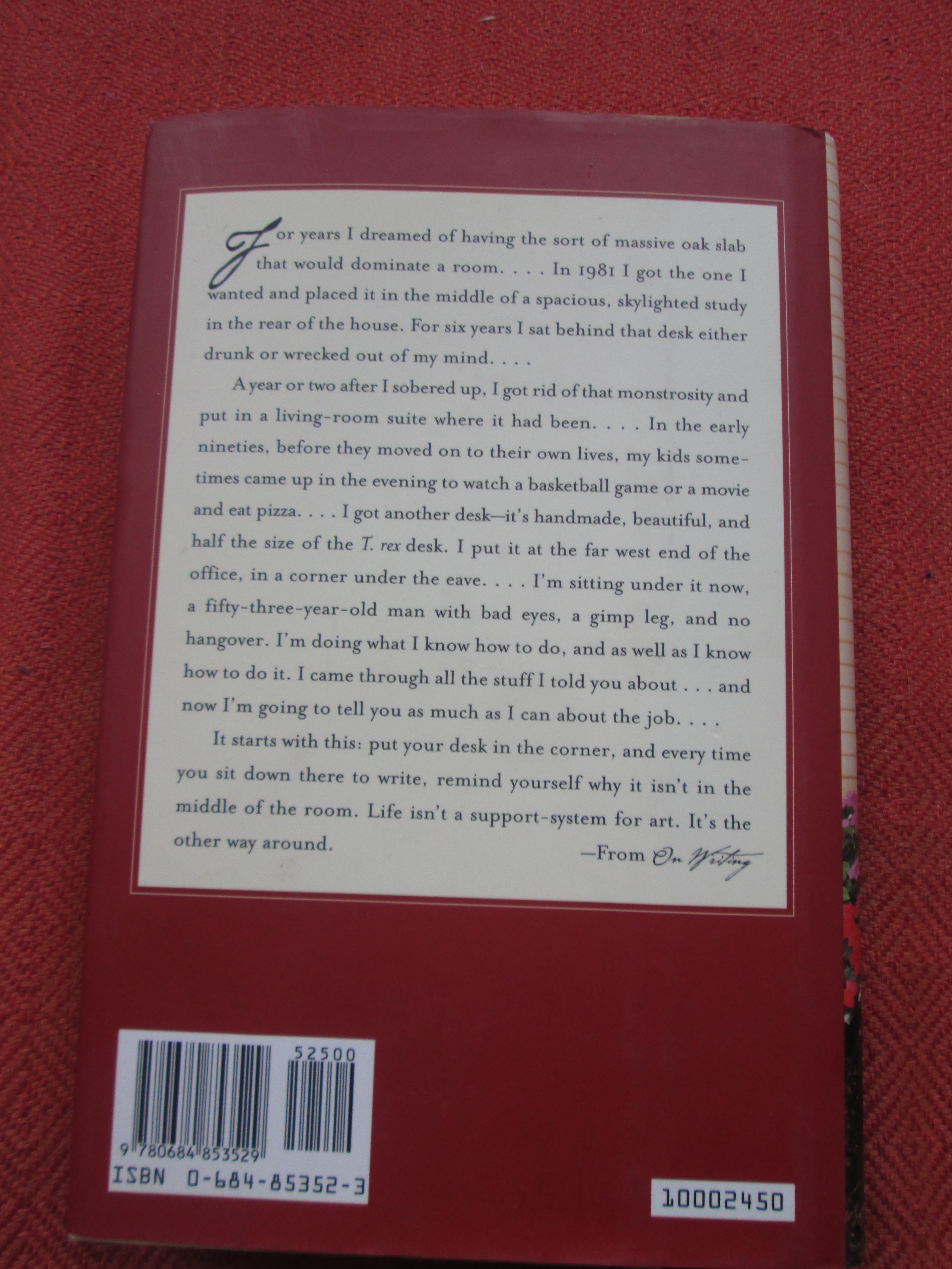
And this. This blurb from the back cover is the real reason I love this book.

IMG_0619

“For years I dreamed of having the sort of massive oak slab that would dominate a room…. In 1981 I got the one I wanted and placed it in the middle of a spacious, skylighted study in the rear of the house. For six years I sat behind that desk either drunk or wrecked out of my mind….
A year or two after I sobered up, I got rid of that monstrosity and put in a living-room suite where it had been…. In the early nineties, before they moved on to their own lives, my kids sometimes came up in the evening to watch a basketball game or a movie and eat pizza…. I got another desk – it’s handmade, beautiful, and half the size of the T. rex desk. I put it at the far west end of the office, in a corner under the eave…. I’m sitting under it now, a fifty-three-year-old man with bad eyes, a gimp leg, and no hangover. I’m doing what I know how to do, and as well as I know how to do it. I came through all the stuff I told you about…and now I’m going to tell you as much as I can about the job….
It starts with this: put your desk in the corner, and every time you sit down there to write, remind yourself why it isn’t in the middle of the room. Life isn’t a support system for art. It’s the other way around.”

That inspires me, people. That’s real and it’s true and it’s absolutely what I aspire to be about this year and in my life moving forward. And you don’t have to be a writer for the truth of that last line to ring through your day to day life.

Sail on, friends, and may even the cold, cold winds be ones of inspiration.