How to Tell a Story – The Four Step Method

You probably think you aren’t any good at making up stories.  I mean, I hope that isn’t true, but the vast majority of people I talk to say the same things.  “You write stories?  I could never just make up something out of my head like that.”  “I’m not really that creative.  I couldn’t think of anything that my kids would want to listen to.”  “I can draw, but when I try to think of words, my mind just goes blank.”

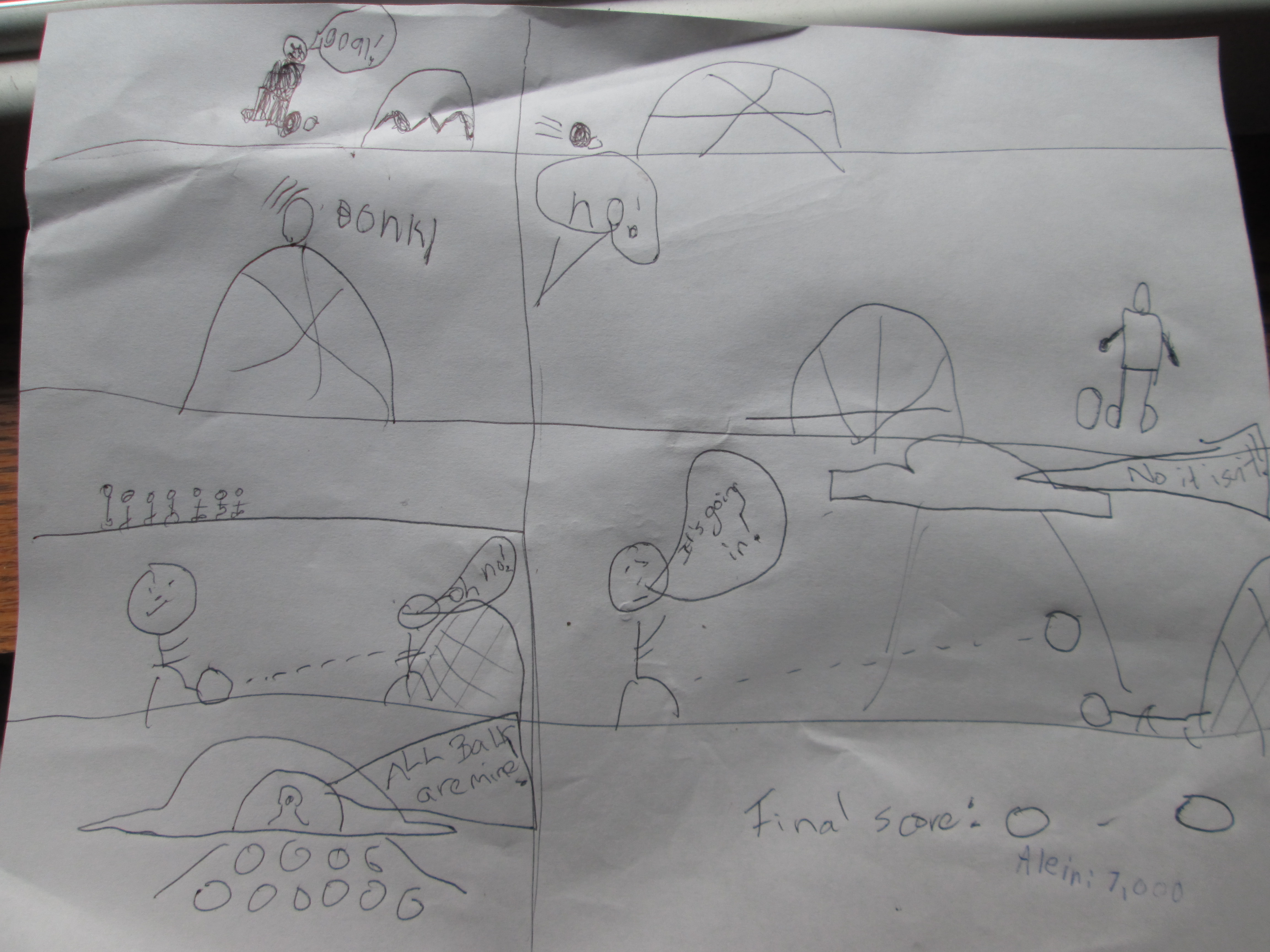
I get it.  I have zero talent in the visual art department, so I mostly say the same things about drawing.  BUT.  I do sometimes scribble things for my kids.  I sit down with them and “paint” awful landscapes.  Yesterday I even sketched out comics with my son to keep them all quiet in church.  We’re talking stick figures here.  I don’t do it a lot because that’s not my thing, but I do care about them appreciating visual art and I do want them to explore their own possible talent.  (I think my son has the makings of a great cartoonist, but then, I’m his mother, what am I going to say?)  So I suck it up, keep it simple, and put something on paper.  I hope maybe along the way I’m also teaching them to be brave and do things even when they aren’t very good at it.

Did I not say stick figures?  Did I not say “zero talent”?  You probably can’t even tell which parts were drawn by the 7-year-old and which were drawn by me.
IMG_0383

I think you should do the same thing with storytelling, and I’m going to tell you exactly how to do it.  (I’m bossy like that.) You should make up stories for your kids.  Not every day.  Maybe not even regularly if that’s not your thing.  But I think you should try it.  I think you should surprise them with a tale from time to time.  Show them that you value stories.  Encourage them by example to try out their own storytelling talents.  Also…trust me on this…it will be fun.  You may be sweating bullets, but you are going to love how entertained they will be.

Because they WILL be entertained.  I’m telling you, especially if your kids are under the age of 8, it takes next to nothing to draw them in.  They will giggle or shiver or hold their breath anxiously at the lamest ofstories.  Even older kids will listen pretty attentively (admittedly while rolling their eyes).  I’ve tried this out on a ton of kids of all personalities.  It works every time.  Just trust me.  I mean, don’t pull them away from their favorite video game or TV show and expect them to be impressed.  But the next time they’re bored in the car or waiting at the doctor’s office, that’s your moment.

Keep it simple.  Keep it fairly short.  Follow these four steps and then when it ends all too soon, ask them to make up one of their own.  You can even walk them through the steps.  Ready?

  1. Think of a character.  It can be anything: an animal, a person, a robot, a monster.  Don’t overthink it.  Just use the first thing that pops into your head (Kangaroo!  Firefighter!  Little girl named Runka!)
  2. Think of the weirdest thing that character could do regularly. This can be anything that person/thing wouldn’t do in the real world.  Again, use the first thing you think of, even if it isn’t exciting.  (A kangaroo that talks!  A firefighter that tap dances through fires!  A little girl named Runka who flies!)
  3. Think of the most obvious problem that weird action could cause.  We’re still going with the first thing you think of, but now you don’t have to think of anything weird.  Just natural consequences.  You’re a parent.  You’re all over these.  (Talking kangaroo gets captured and put on display in a circus.  Tap dancing firefighter trips in a fiery building.  Flying Runka doesn’t know how to land.)
  4. Find the most logical solution to their problem.  The solution can involve other people, or they can save themselves.  They can learn their lesson or keep having the same problem forever.  Whatever comes to you in the moment will work, as long as the problem gets solved in some way.  If you’re stuck, just think about what you would do if you were stuck in that problem.  (Circus kangaroo escapes but can’t stop talking and is in and out of zoos the rest of its life.  Tap dancing firefighter is rescued by his crew and decides to save his tap dancing for the stage instead of fires.  Flying Runka crashes into a tree, which breaks her fall, so she goes around planting trees to land in, so she can fly wherever she wants.)

And just like that, you have a story.  If you feel creative, you can embellish, add details, put in twists and turns.  But if you don’t feel it, or if you are an inherently logic-driven person, no worries.  Only step two requires any creativity, and that’s just basically thinking of what makes sense and then picking the opposite.  You can handle that.  Let me emphasize again, it doesn’t matter if it seems lame to you.  The genius of stories paired with kids’ flexible brains is that they are visualizing it and embellishing it in their own minds without even realizing it.  Which, in addition to meaning it’s more fun in their heads than in yours, basically means you are making them smarter.  (That is based on absolutely no scientific research, but it’s totally true.)

Here’s me making up one with no extra thought at all:

1. George

2. Turns somersaults.

3.  Gets really dizzy.

4.  Goes to the doctor who runs tests and can’t find anything wrong.  Then George does a somersault in the office, and the doctor says, “Hey, maybe don’t that anymore.”  George can’t stop, though, so he staggers through the rest of his life, occasionally rolling over to the amusement of all his friends.

Obviously, that is a super short story, but when you add in some description (How old is George?  How many somersaults?  How dizzy was he?  Dizzy enough to throw up?) it’s pretty complete.  And even if the details aren’t easy for you, you can always get kids to help you.  They like an interactive story.  (One there was a man named George.  What do you think he looked like?  You are right!  Well, George really liked to turn somersaults.  He did it all day long.  How many somersaults do you think he can do in one day?)

Try it!  (Please?)  You may just impress your kids a little.  You may just impress yourself a little.

I’ve got a couple of other story methods for you try out.  I’ll try to get them out to you soon.  In the mean time, here’s where the four step method originated.

And you really ought to read about HOW TO TURN ORDINARY STORIES INTO JAW DROPPING THRILL RIDES.


If you liked The Hunger Games (YA reads I loved…and a few I hated)

Even though my own books (so far) are more middle grade, I read a ton of YA novels for “research.”  Here I give you some of my favorites on the YA fantasy/sci-fi side of things, and, because I couldn’t resist, a few warnings.  Everything on the top part of this list is a book/series I can’t wait for my kids to read.  They’re also all books I’m not giving them yet because, in my opinion, there’s some reason (usually the emphasis on the romance) to make it more appropriate for the 13 and up crowd.  I was a huge fan of The Hunger Games (even the ending), and this list presupposes that you’ve already read that series.  If you haven’t, by all means start there.  That’s certainly the first one I’m handing my daughter when she’s just a couple of years older.  No one else does character development and plot movement all at the same time quite like Suzanne Collins.

If You Liked The Hunger Games (even if you hated the ending)

Divergent by Veronica Roth – You’re probably already onto this one, what with the new movie and all.  Book 1 struck me as the best of the Hunger Games inspired novels.  Loved the character of Tris, was fascinated by the world created.  Then Book 2 annoyed me a bit, but delivered just enough.  Then I hated Book 3.  I’ll do a review sometime to explain.  Suffice it to say, I was mad enough that I haven’t watched the movie.  So read Divergent! But maybe don’t finish the series.  You’ll be happier that way.

The Giver by Lois Lowry – These books are curious.  Each in the series is apparently unrelated and yet obviously in the same universe.  They involve kids making discoveries about their world and breaking away to make life richer and fuller.  They are more cerebral than most in the genre and move a bit too slowly.  I enjoyed them without being moved by them.

Matched by Ally Condie – More dystopian romance.  There isn’t a ton of depth here, though it likes to pretend there is, but if you are a fan of the genre, you’ll enjoy the series.  It isn’t annoying like some.  Not much more to say about it.

The 100 by Kass Morgan – 100 juvenile delinquents are sent down from their space station home to see if the post-nuclear-war earth is livable again.  Complete with a truly smart, pragmatic, kick-a** heroine.  I highly recommend this one.  The new CW series is pretty darn good, but the book is better.  I can’t wait for the next in the series.

Ender’s Game by Orson Scott Card – The rest of the series is probably more for adults than teens, but this book is amazing.  Amazing.  If you want to know what it’s like to be an exceptional child, this is the book to read.  I’m not worried about content on this one.  I’m only waiting for my kids to be old enough to really appreciate it because this one is going to make them feel understood, hopefully right when they’re at the age where they need that.

Steelheart by Brandon Sanderson – It’s really hard to do the super-hero thing in a way that doesn’t feel recycled, but he pulls it off.  Solid world, interesting characters, fast-paced action.  Here’s one your sons will like as much as your daughters.

Legend by Marie Lu – More dystopian romance, but this is my new favorite (after the Hunger Games).  Mostly that’s because of the awesome combination of Thinker Female Lead and Feeler Male Lead (a la X-Files).  This is one of my favorite things.  I love the rational girls and their intuitive men (probably because it’s my own life dynamic).  I can highly recommend all three books, and the ending was slightly unexpected and perfect.  How often can you say that?

Life as We Knew It by Susan Beth Pfeffer – Sci-fi novel about a girl and her family trying to survive in a world where the moon has gotten too close and it destroying everything.  I LOVE survival novels and this one gets all the family dynamics just right.  It’s a gripping read.

The Age of Miracles by Karen Thompson Walker – Another survival novel, but this time the world’s rotation is slowing.  Not quite as strong as Life as We Knew It, but I still really enjoyed it.

Graceling by Kristin Cashore – This one is fantasy, about a girl with supernatural fighting skills.  It does get a little steamy in places, and takes a moral posture at the end that left me dissatisfied, so maybe save this for older teens?  But.  The main character’s thoughts and motivations throughout most of the book were so resonant for me that on balance I’m calling it a keeper.  For the record, I have read some of the sequels, and the author continued to impress me with her unconventional intelligence while making me a bit uncomfortable with her worldview.  Bottom line – approach the series with your critical thinking turned on.

I’d Skip Them

The Maze Runner by James Dashner – More dystopian sci-fi, this time with lots of boys.  Here’s the thing:  I really liked the world he created, and the plot isn’t bad.  BUT.  The writing is terrible.  Like painfully bad.  I kept forcing my way through and managed to finish two books in the series, but I just couldn’t do any more.  It’s too bad.  It’s an interesting concept.  Maybe the movie will be better than the books.

Delirium by Lauren Oliver – Yet another dystopian romance, this time about a society where love (and any feeling really) is outlawed.  Yes, that’s just as cheesy as it sounds.  And just by telling you the premise, you can already tell me everything about the book.  Let’s just say it involves the discovery of poetry by teenagers.  The writing is decent, but the content is so trite and cloyed that I can’t recommend it.

Don’t Do It!

Shatter Me by Tahereh Mafi – Okay, I started this thinking it was another series inspired by The Hunger Games only to realize that it must have actually been inspired by Twilight (which for the record, I didn’t read and never will).  The first book was bearable because, though the plot was totally unoriginal, it focused on an exploration of a deeply damaged girl who was mostly trapped inside her mind.  Then it completely jumps the shark in the next book and just keeps getting worse and worse as it drags you through endless teenage drama, abruptly redefines characters, and shamelessly rips off the X-Men.  Igh.

If you’re looking for a list for younger kids, check it out here, or click the Book Recommedations Tab above.

The Broken Mirror

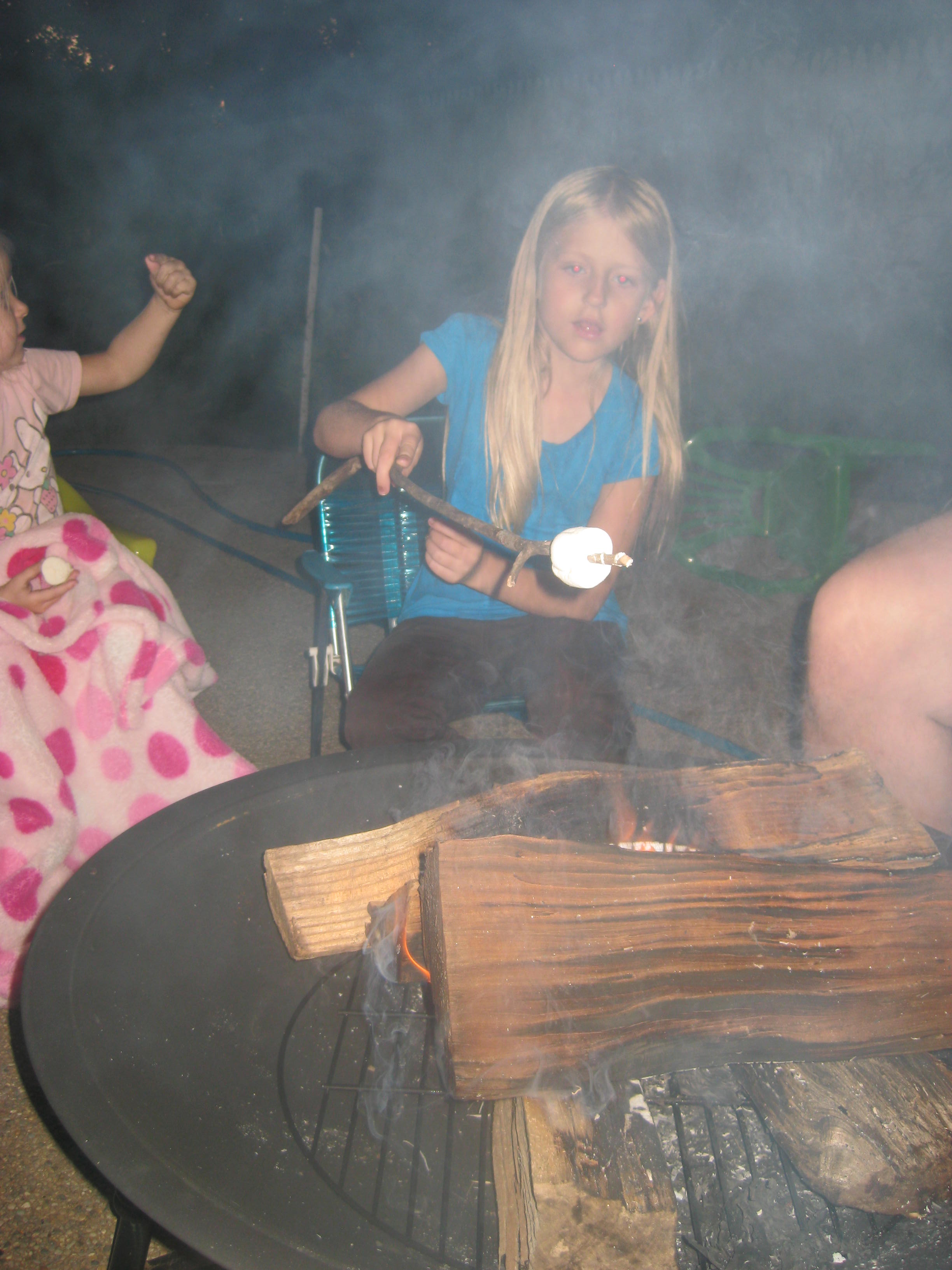
One of our happiest summer traditions is a blazing fire in the fire pit, s’mores, drinks, and stories.  The kids like them scary.  The parents like them funny.  Everyone takes a turn.  This is the one they pried out of me the other week, not exactly high drama but good for a little shiver on a hot night.

IMG_3067

Once upon a time there were three children who lived with their parents in an ordinary neighborhood on the edge of town.  They had lots of friends all up and down the street, and they spent hours playing basketball and running through sprinklers and riding bikes and climbing trees with their friends.  The three kids were lucky, though, because they lived at the edge of town and the dense woods grew right up to their back fence.  There was a little gate in their fence that led out into the woods, and the three kids loved to slip through the gate and play in the woods.  They were the only ones with such a convenient gate, so they often had the woods to themselves, which was just the way they liked it.

One summer day the three children were busy building a fort in the woods.  They gathered interesting sticks and smooth stones and the occasional piece of old fence or broken garden pots that neighbors had thrown out under the trees.  The middle child (and only boy) knotted an old rope around a branch for lifting things up, and the oldest fitted things together to make rough walls and a floor, while the littlest poked about among the leaves on the forest floor gathering beautiful odds and ends to decorate their playhouse.  That was how she came to find the most wonderful treasure of the afternoon.  Nestled in the moss at the foot of a tall pine was a shining silver circle.

The little girl picked it up, brushed off some dirt, and turned it over.  It was a mirror, cracked down the middle but set in a silver case that held the pieces together.  She was so excited when she saw it that she ran immediately to show her brother and sister.  They all agreed it should have a place of honor in the playhouse, and they worked together to rig a little shelf for it to sit on.  So the afternoon passed happily, and the playhouse came together nicely, and as they worked, each of the children would glance over from time to time at the little mirror and think how pretty it was glittering on their wall.  They each thought to themselves that the playhouse reflected in the mirror was much more magical and wonderful than the playhouse in the real world.

As dinner time approached, they knew they wouldn’t have much longer to play, so the oldest called a meeting.  “This is the best playhouse we’ve ever made,” she said, “and I think we should try to keep it as nice as possible.”  They all agreed.  “We all need to promise right now that we won’t tell anyone else about our playhouse or let anyone else come back here to find it.  That way no one will wreck it.”  Her brother nodded, but the littlest furrowed her brow.  She had been looking forward to showing the playhouse off to her little friend down the street.  “This is really important,” her big sister explained.  “If anyone else comes here they might knock things down.  They might break our mirror or take it when we aren’t looking.”  The littlest couldn’t bear the idea of something happening to the mirror, so she agreed that the playhouse would be their own special secret.  “I wish we could play here forever,” the oldest concluded, “and that no one would ever bother us, but we’d better go home for dinner.  If we aren’t on time, Mom and Dad may come looking for us, and then they would find out where our playhouse is.”

Again they all agreed, and they hurried through the trees towards their own little gate, each casting one last look at the mirror glittering on their playhouse wall but none noticing the little flash of light that burst out of it just before they were out of sight.

They went into their back yard and up the back steps into the kitchen.  Instead of their mother standing at the stove finishing dinner as they expected, they found the room chilly and dark.

“Mom!  We’re back!” they shouted.  No one answered.

“Dad!  We’re back!  Where’s mom?” they shouted, sticking their heads into their father’s study.  No one was there.

“Mom?  Dad?” they yelled, stomping up the stairs.  The house was completely silent.

The kids searched every room.  They were all empty.

They went out into the yard and yelled again.  There was no answer.  They went into the front yard and shouted as loud as they could.  No one replied.

As their own shouts died away, the three children noticed that the street was unusually quiet.  They began to get a very, very uncomfortable feeling in their stomachs.  The littlest felt tears already poking out of the edges of her eyes.

They thought maybe they should ask some of the neighbors if they had seen their parents, so they went next door and knocked.  No one answered.  They went across the street.  The house was seemed deserted.  Up and down the street they went, ringing doorbells and peering into backyards.  Everyone was gone.

Everyone.  Suddenly the middle child gave a great yell.  His sisters came running.  He was standing outside the last house on the street, pointing at the front door.  The girls immediately saw what had made his face go white.  The door had a tiny window in it, larger than a peephole, but still just as perfectly round.   It was edged in silver and a crack right down the middle.  It reminded them distinctly of something they had once thought beautiful, but this didn’t seem beautiful at all.  Standing here on the empty street, all alone, that cracked window looked ominous and disturbing.

“They’re all cracked,” said the littlest.  She was pointing at the rest of the house.  Sure enough, when the kids looked closer they saw that all the windows, whether big or small or square or rectangle, had a single crack running right down the center.

Slowly they backed away from the house and began to move toward home.  That was when they noticed that all the houses were the same.  Cracked windows.  Cracked windows.  Cracked windows.

The kids began to run, and they ran all the way to their house, through the front door, up the stairs, and into the girls bedroom.  There they stood, panting and clutching each other until the oldest said with a tremble in her voice, “I think we should go into the bathroom.  Remember what Mom always said when we talked about tornadoes?  No windows in the bathroom.”  She was looking at their bedroom window and its enormous, dividing crack.

They crept into the bathroom, and the oldest turned on the light.  There before her, she saw herself reflected in the mirror, and she had a crack right down the middle of her face.  She grabbed her sobbing sister and backed out into the hallway.

“You know where we need to go, don’t you?” said her brother.

“Yes,” she said.

“I’m scared,” said the littlest.

“We know,” said her siblings.  “We are, too.  Let’s do this together.”

Slowly and carefully now, trembling with every step, the three children went out into the back yard, through the little gate, and into the woods.  Shadows were falling all around, making the trees look taller and more menacing.  They made their way to the playhouse and stopped just outside.

“Who’s going to do it?” whispered the oldest.

“We all will,” said her brother.

Together they went into the playhouse and took the mirror off the wall.  On the count of three, they hurled it out the door as hard as they could.  It flew through the air, a glittering arc, as beautiful as ever in spite of their fear.  Then it smashed into the trunk of a tree and burst into a million pieces.  This time they all saw the flash of light that darted out on impact.  Together, they breathed a sigh of relief.

“Do you think that did it?” asked the middle child.

“I don’t know,” said the oldest.

“I hope so,” said the littlest.

“Kids!” called their mother.  “It’s time for dinner!”

And the three happiest children in the whole world went in to eat and to tell their parents all about their new playhouse and their plans to invite over every kid on the street to play in it.

The last campfire tale I told them:  The Window.

Another scary story: Little Red Didn’t Listen


Why I Tell Stories

mesuitcase

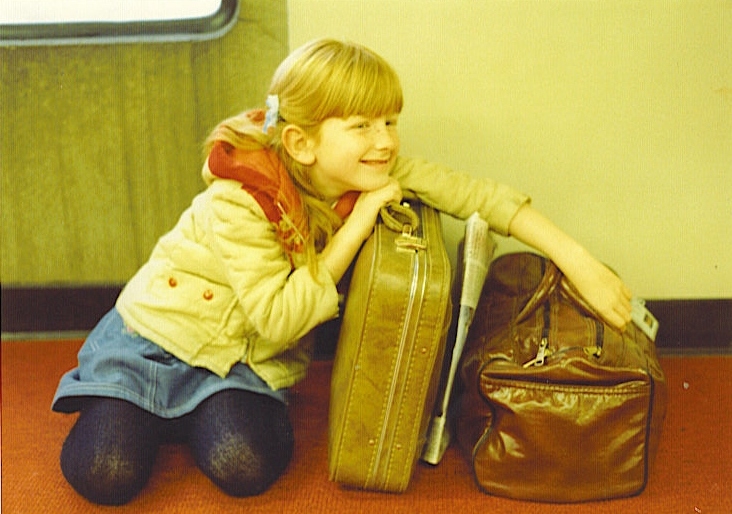
Once upon a time there was a girl who was in a hurry to grow up.  She wanted to be independent.  She wanted to be and go and do.  And most of all, she wanted people to take her seriously.  Naturally, she did grow up, as you do.  She went to college, traveled, got married, got a job, and was as grown up as she had imagined being.  She was surprised at what she discovered in grown up life.  She found that being independent was only fun with other people around to share it.  She found that, very like childhood, what she wanted to be was happy, where she wanted to go was a place in her imagination, and what she wanted to do was share a Slurpee with her best friend.  In the end, she even found that she would like people to take her a little less seriously.  That last discovery gave her the freedom to say out loud some of the things she had been thinking all her life, to make believe with other people and not just inside her head.  Which was, of course, the moment she was truly grown up.

1yochristmas

Once upon a time there was a brand new mother.  Her little tiny baby was precious and wonderful and wanted to be held and talked to every moment of every day.  This mommy loved her baby, but day after day the baby just lay there, looking extremely cute but not actually doing anything interesting.  The baby grew.  The mommy’s love grew, too, and so did her boredom.  The baby wanted her mommy’s attention, so there were very exciting breaks.  The baby wanted to play with little toys, which she pushed back and forth on the floor in the world’s most boring way.  The baby’s eyes sparkled, but her conversation skills were distinctly lacking.  The mommy began to feel that she was going to lose her mind with all this adorable tedium.  Then she discovered that stories could save her.  She learned to read a book with one hand while building a block tower with the other hand.  She learned how to read a book while pushing a stroller.  Then another baby came along, and she learned how to read a book while feeding a toddler with one hand and bouncing a baby in a chair with her foot.  Then when things got really crazy, she learned how to think out stories in great detail so that her mind could roam free in open spaces while her hands changed diapers and pushed swings and folded laundry.  Which is how the endless round of duties began to feel less like serving a life sentence and more like truly having a life.

IMG_4727

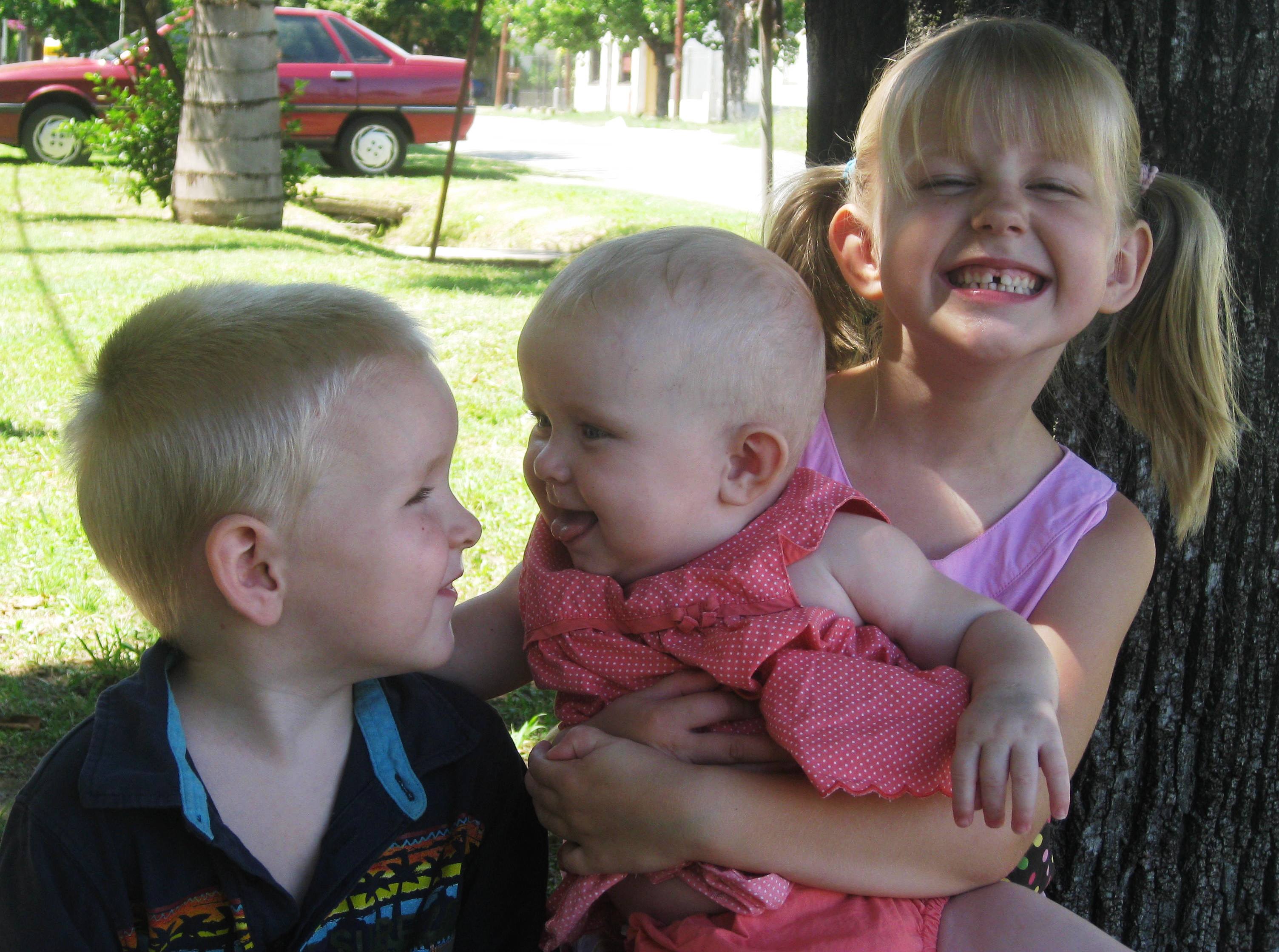
Once upon a time there was a mother with three beautiful, intelligent, charming, headstrong, emotional, intense and overwhelming children.  When they were still quite little, her life was full of the drama and misadventures that only extraordinary little people can bring.  A simple drive to the store would result in a (not so) well-reasoned argument about why they should just keep going the two hours to Grandma’s house.  The time it took to make a box of macaroni and cheese was enough for a toddler to grow monkey arms and hang around the knees like an inconveniently-placed, shrieking backpack.  And God forbid simple grooming habits need to be cared for, such a a bath or the removal of tangles.  Life with the three children challenged every part of of the mother’s being.  In desperation, she turned to the thing that had helped her through all the worst moments of her life: stories.  When a comb was in hand, a story could be the difference between a little girl terrifying the neighbors with her screams and the occasional, inevitable, moan or yelp of pain.  On car rides of all lengths, a story could be the difference between a string of unending questions and a string of unending giggles.  And on long afternoons when older siblings had at last gone off to school, a story could be a difference between a fifteenth request for craft time and a snuggle on the couch.  So the stories grew, as stories do, and took on a life of their own, and soon the three extraordinary children began to invent their own extraordinary stories.  Which, of course, gave the mommy a break, and also delighted every part of her being.

If You Liked Harry Potter (what your elementary aged kids should be reading)

I read A LOT.  Like seriously, an embarrassing amount.  It’s how I stay sane in the mundane world of motherhood.  (Also, it’s fun.)  My kids also read a ton, so we are constantly on the hunt for new, awesome books to consume.  I can’t tell you how excited I get when I see pages of book recommendations.  In light of that, I thought I’d put out there a list of our own favorites to help out anyone who’s in the same boat.  Then, you know, if you want to toss some suggestions my way in the comments, we all win!

This will be a running series.  In future posts, I’ll put up my favorite YA novels, my favorite sci-fi, etc.  The complete compiled list can be found on the little tab above that’s creatively called Book Recommendations.

This list only includes title and author and a short description, but I’m going to be working on adding book reviews to the blog, so as I get longer reviews up, the links will be on the Book Recommendations page, too.  Check back from time to time, I’m always reading more (and so are the nerdlings) so this list is going to grow.

If you liked Harry Potter (and if you didn’t, I can’t help you)
For kids of all ages (With a focus on the 7-11 crowd)

  • A Series of Unfortunate Events by Lemony Snicket – Just so, so much word play and sibling awesomeness.  Since these are two of my favorite things, I have been smitten for a long time.  And both my girls (even the one who just turned 5) have loved these.
  • Who Could That Be at This Hour? by Lemony Snicket – First of a four-book series called All the Wrong Questions which is already genius before you can even get past the title.  Classic Lemony Snicket style with a twist of mystery thrown in.
  • The Chronicles of Narnia by C.S. Lewis – Not like you wouldn’t have thought of these on your own, but in case you’re wondering, the first five books (original numbers) are as good as you remember (really wonderful and surprisingly short) and the last two…eh.  Do not make the mistake of starting with The Magician’s Nephew.  Also, this is the one case where the movies are as good as/better than the books.
  • The Sisters Grimm by Michael Buckley – Gets five stars as my 9-year-old daughter’s favorite series ever.  Fun and funny and full of fairy-tale references. [end of alliteration]
  • N.E.R.D.S. by Michael Buckley – More by the author of The Sisters Grimm, this is a team of geeky kid spies of both genders which appealed to all of my little nerdlings.
  • Jedi Academy by Jeffrey Brown (of Vader and Son fame)- This one is for the younger end of the spectrum, but you can’t go wrong with the Star Wars universe and kids who don’t have a clue.
  • Warriors (Start with Into the Wild) by Erin Hunter – I really hate to do this to you, parents, but my 9-year-old and her darling nerdy friends are obsessed.  Warrior cats living in clans in the wild.  Elaborate world-building.  Apparently hundreds of books.  Great intro to future fantasy geekdom.
  • On the Edge of the Dark Sea of Darkness by Andrew Peterson – Have you heard of this one?  A little more overt Christian allegory than I would like, but I loved the tongue in cheek style and the fast-paced action.
  • Leviathan by Scott Westerfield – Super steampunky, this is a fun kid adventure in alternate history.  Imagine WWI if the Brits had giant flying airbeasts and the Germans had advanced mechanical walkers.  Creative world building and interesting, well-developed characters.
  • Gregor the Overlander by Suzanne Collins – I’ve only read the first in this series about a boy who falls down into an underworld adventure with roaches and bats and rats.  So you can see why I quit and also why kids would love it.  Remarkably heart warming and (obviously) well-written.
  • The Rithmatist by Brandon Sanderson- This is an odd one, but if you have a math-obsessed nerdling who isn’t as in to reading, I’d recommend giving it a try.  Elaborate system of fighting with chalk drawings, more mentally stimulating than emotionally gripping.
  • Bunnicula by James and Deborah Howe- Do you remember reading this series as a kid?  I hope so.  Easy read for those who are just getting into chapter books, and they are so fun.  Plus it inspires you to search for white carrots to freak your kids out.
  • The Mysterious Benedict Society by Trenton Lee – A motley collection of odd bright children?  Mysteries to solve and puzzles to puzzle over?  Yes and yes, please.  This one is probably better for the 9 and over crowd (just based on difficulty, not on content).
  • A Wrinkle in Time by Madeleine L’Engle- Just read these again as an adult and man, they are weird.  But I can still remember reading about Meg and Calvin and Charles Wallace for the first time all those years ago and feeling understood.
  • In the Hall of the Dragon King by Stephen Lawhead – A more obscure pick from my childhood.  These were my favorite books, my intro to the fantasy genre (went straight from here to The Hobbit), full of kings and sorcerers and brave young men who have to save them all.  Obviously Christian, but leans toward world-view shaping rather than allegory or preachiness.
  • The Phantom Tollbooth by Norton Juster- Please tell me you know about this wonderful classic gem.  So smart, so clever, and so resonant and wise.  Kids may need to be older to get into it, but this is a book that will make your life better.
  • Stick Dog by Tom Watson – Not remotely in the same genre as Harry Potter, but the concept is clever and the writing nimble and my 7-year-old who loved HP finds these books hilarious.  Tom Watson makes a bid deal about how he illustrated this with his own self-proclaimed terrible drawings, and that’s the kind of creative awesomeness I want to support.
  • The Brixton Brothers by Mac Barnett – A modern Hardy Boys.  I haven’t read more than a page or two, but my 7 -year-old son ranks them at the top of his list.  My favorite bit?  There aren’t any brothers. It’s just one kid who is trying to imitate his detective heroes.
  • The City of Ember by Jeanne DuPrau – These books are a really interesting look at human nature and the effects of culture on our choices. So yeah, even though they are definitely for kids aged 9-12, they are serious. A serious adventure. Good books, but not going to appeal to everyone.
  • The Book of Sight by Deborah Dunlevy – What? You didn’t think I was going to recommend my own books? I’ve been living with Alex, Adam, Dominic, Logan, and Eve long enough that they’ve become some of my favorite people. Book Three will be out in just a few weeks! For the record, this is the category I would file these under. So far my happiest fans are aged 9-13.

Inside and Out

This morning Lucy started to tell me a story and then decided halfway through that I should finish it for her. I thought her premise was so quirky and perfectly expressive of her brain that it was worth a Lucy-esque ending. Here’s what we came up with together. Because nothing is more fun that making stuff up with my kids.

Lucy:
Once upon a time there was a beautiful princess who lived in a big castle. She lived there all alone because everyone else had died.

One day a huge giant came to her castle. “I’m going to eat you!” he said to the princess.

(Now, don’t worry. He isn’t going to…well, he IS going to eat her, but it will be okay.)

So then he ate her in one big bite, but she didn’t die. She went inside him. You know. And inside him she went to a beautiful land.

And the thing is that he was a bad giant, but he used to be a good giant, only all his niceness was down inside him now, and the badness was on the outside. So down inside him, she was in his niceness.

I want you to finish the story.

ID-10076800

Mommy:
So inside his belly, all his niceness had made this beautiful land, and the princess wandered the beautiful land looking at rainbows and flowers and everything happy and nice, and there, under an apple tree she saw a boy. When she got closer, she realized that it was her brother!

She ran up and gave him a hug. “I thought you were dead!” she said.

Her brother laughed. “Well, I WAS eaten by a giant, but instead of dying I found myself here in the beautiful land. Ad guess what else I found?”

Then her brother took her by the hand and showed her where her mother and father and grandmother and aunts and uncles and cousins were all living among the rainbows and flowers. Every single one of them had been eaten by the giant!

Her mother hugged her. “We’ve missed you so much! We wanted to see you, but we couldn’t figure out how to get out of this giant. Now that you are here, though, we can stay here happy forever.”

The princess knew that was a bad idea, though. The people in the kingdom were counting on the royal family to protect them, and on the outside, the giant was still very bad and very likely to keep eating people. Then their families would be so sad, just like she had been when she thought her family was dead.

“We need to find a way out of here,” she said. And she came up with the perfect idea. She and her family picked thousands of leaves and flowers and wove them together into a giant hot air balloon. Then they built a little fire and puffed up the balloon and floated up, up, up, the giant’s throat and right out of his mouth!

The giant was so surprised when a beautiful hot air balloon came out of his mouth that for just a minute he forgot to be bad. “What is this? Where did you come from?” he asked.

“We came from inside you!” the princess answered. “All these beautiful flowers were right down in your belly. You are still very, very nice in there!”

The giant was amazed, and he loved the balloon, and he remembered when he used to feel all those nice things all the time, so he decided that he would be a nice giant again, and let all that niceness back out.

So the princess and her family went back to live together in their castle, and the very nice giant helped them make their land the most beautiful land in the world.

(Image above courtesy of twobee/FreeDigitalPhotos.net)

Penny

Once upon a time in a small village between two mountains there was a little girl who had power over the wind and sun. She didn’t look like someone who would have such immense magical powers. She was small for her age and freckled and had hair that couldn’t make up it’s mind if it was blonde or brown and eyes of faded blue that twinkled when she talked but otherwise attracted no attention.

She didn’t act like someone who would have supernatural abilities either. She went to school (where she only did fine and not outstanding) and helped her mother around the house (though she often forgot the proper way to sweep a floor) and played with the village children (who outran her in games of tag and dared her to walk fence lines without a single care for whether or not it would rain).

She didn’t know any secret magic words. She didn’t have a mysterious old grandmother or aunt who cast a spell on her as a baby. She didn’t have a magic cloak or a name of power. She wore clothes made by her mother and her name was Penny (though most people called her plain old Pen).

Still, the fact remained that when plain old Pen walked out her door with an umbrella, the clouds would roll in and the rain would pour down. When Penny picked out a sundress on an early spring morning, the air would immediately begin to warm. When Penny appeared in the village wearing snow boots and a fur-lined coat, everyone brought in extra firewood, knowing the snow would fall any minute.

There were a few who didn’t believe, of course. The village seamstress (who had studied at a university and taught school for several years before realizing that she really didn’t like children) was adamant that such magic could not exist. She insisted that it was all coincidence and silly superstition. Old Granny Spencer was too smart to believe in coincidence, but she didn’t see how a little slip of a thing like that could control something so wild and free as the wind and the rain. Instead she told all she met that Penny could merely sense the weather before it came, much the way Granny’s own knee ached when the rain was rolling in.

Several of the village children, led by little Nanny Whipple, thought Penny too plain to have such powers. They were sure it was just her magical boots that made the rain. They yelled this loudly on the playground until the day that Nanny worked up the courage to swipe Penny’s boots. She was bold enough to wear them to school the next day, bragging of how she would make it rain. Penny came to school barefoot that day, and it was the warmest April day that anyone had ever seen, a perfect, cloudless summer day come too early. That night Penny found her boots sitting outside her front door, and the children’s playground taunts turned to someone else.

So the children’s doubts were silenced, and with very few exceptions the grown-ups all believed in Penny’s powers. It was only a matter of time before they all began to think of using these strange powers to their own advantage.

It was Eleanor Pratt, the mayor’s daughter, who first approached Penny with a gift. Eleanor was getting married on Saturday and had planned the loveliest wedding under the willows down by the stream. The only thing that could ruin it’s perfection would be rain. Smart girl that Eleanor was, she never mentioned the weather to Penny at all, just gave her the prettiest pink sundress sprinkled over with delicate flowers. “I hope you’ll wear this to my wedding on Saturday,” she said in answer to Penny’s squeals. Penny did, and they all danced in the brilliant sunshine that day.

The farmers were the next to show up at Penny’s door. It had been a warm summer (not surprising, as Penny was running around barefoot and swimming in the creek every day). After three rainless weeks, a string of gifts began arriving for Penny. Three umbrellas, two pairs of galoshes, and a lovely waterproof rain coat. This last gift was shiny and polka-dotted, and Penny couldn’t help but try it on. The farmers breathed a sigh of relief as a warm, steady rain fell on their parched crops.

It didn’t take long, of course, for things to become ridiculous. By the end of summer, it wasn’t uncommon for Penny’s mother to find a pile of gifts outside the door: a warm woolen scarf from a grandmother who was tired of the summer heat, a pink parasol from a housewife planning a picnic, a rain hat from another housewife who had not been invited to the picnic and was determined to ruin it, and three kites from hopeful children who wanted enough wind to fly their own.

Naturally, there was no way for Penny to use all these things at once, and there was no way for everyone to get the kind of weather that they wanted. Someone was always disappointed and some of them became angry. They would stop Penny on the street to beg, bribe, or threaten her, depending on their mood. She became quite frightened after a while, and her mother was extremely worried. After one horrible encounter in which three angry women tried to force a pair of rain boots onto Penny’s feet right in the middle of town square, Penny’s mother tucked her up into bed, closed all the shutters to the house and refused to let Penny go out at all.

For a week Penny stayed inside, and for a week the weather was suspended. It may seem impossible for there to be no weather at all, but that is exactly how it felt. No wind, no rain, no clouds at all. The sun was in the sky, but it brought no warmth to the air, no sparkle to the stream, no brilliance to the plants and trees. It was as if the whole world was holding its breath.

The gifts piled up around Penny’s door. After a few days, the givers began to pound on the door, more and more insistent the longer that no one answered.

Inside, Penny’s mother and father came to a decision. The village was no longer a safe place for Penny. They would take her to the big city where there were so many people and so much bustle that no one would notice one little girl and her connection to the sky. Quietly they packed their things and made their plans.

The next day, a group of villagers arrived at Penny’s house. The strange unweather had filled them with unease, so that they determined to break down the door if necessary and bring the little girl out by force. There was some argument about what kind of weather they wanted, but they all felt that anything would be better than this.

Boom! Boom! The men’s booted feet crashed into the wooden door. The air outside was still and heavy. Boom! Boom! Crack! The lock began to give way, and a chill swept over the crowd as clouds silently rolled in. Boom! Boom! Thud! The door flew off it’s hinges and hit the floor. At that precise moment sheets of rain began to pour out of the sky. A few of the villagers cheered in relief at this immediate change. The wiser ones cast a dark eye at the sky and hurried into the house.

It was empty. Penny and her family were no where to be found. The hearth was cold. Food and clothing were missing. It was clear that they had left in the night and did not plan to come back. The crowd finally made its way up to Penny’s room where they found a huge pile of discarded hats and gloves and boots and umbrellas and sunglasses. The mayor, who had been carrying a sweater and hoping for the weather to cool, threw it down in disgust.

CRACK! A jag of lightning split the sky. There was a cry from outside, and everyone rushed down. The storm was in a fury, gust of cold wind and hot wind alternately whipped the town, rain pelted their heads, mixed with bits of hail and snow. Thunder boomed. It was as if all the weather they hadn’t had in the last week was visiting them at once. But that was not what caught the mayor’s attention. The first thing he saw was his house. It was on fire.

That day the lightning burned up seven different buildings around town. The fires did not spread due to the unceasing rain, but each time lightning struck, a new building was charred from the inside out. When the weather finally spent its full fury, the villagers were left feeling quite as hollow as those husks of buildings.

They rebuilt. They replanted. They lived very quietly. No one ever mentioned Penny, and no one ever saw her again. And no one ever complained about the weather.

And far away in the city, the rain came and went, and sunny summer passed into windy fall and snowy winter, and no one ever noticed the sweet little girl who was always perfectly prepared for any kind of weather.

Fritz and the Mystery of the Waters, Part 2

Early one Sunday morning, Fritz put his boat into the rushing water and let it carry him away.

He told no one where he was going. He didn’t want to worry them. Instead, he wrapped up food, an empty bottle for water, and some dry clothes in a big bundle, tied it all to his back, and set off alone. He knew nothing about sailing a boat, of course, so he had no way to steer, no way to stop, no way to control his own fate. He just stepped into the boat, tipped it off the edge into the flood and held on tight.

It was exhilarating. Wind whipped past his face as the water sped him along. The boat rocked back and forth but stayed afloat, and gradually Fritz loosened his tight grip on its sides. The moon and stars gave just enough light for him to see that he was all alone, a tiny, bobbing speck on a vast gurgling sea of water. A feeling of such loneliness overcame him that he almost regretted his decision. It was too late now, and anyway, the feeling of complete freedom that came from speeding along in the darkness soon overcame his fear.

The sun came up, and Fritz sailed on. Now he could see the distant mountains on either side of the great plain filled with water. Behind, the mountains were just a smudge, too far away to see. The village of Burgh was out of sight. Ahead, water stretched on to the horizon. Fritz sailed on all day. He ate some food. He slept a bit. He filled his bottles with water, reaching very carefully over the side of the boat. The sun went down. The boat moved on. Fritz sailed through the darkness again.

With no stilted houses to measure the height of the water, Fritz didn’t even notice when the level began to drop. He did eventually sense that the boat was going a bit slower than before. Then he felt a tiny bump. Then a scrape. Then the boat jerked to a halt, throwing him forward a bit. The bottom had hit mud and stuck tight. A foot of water still flowed around Fritz’s feet as he got out to investigate. Then just a few inches. Then just a trickle. Then nothing. It was hard to see much by moonlight, but as far as Fritz could tell, mud was on every side. Nothing but mud, exactly like at home. A flash of intense disappointment struck him. He sat down in his boat to wait for daylight and the long walk home. Emptiness eventually buried him in sleep.

As often happens, daylight brought many changes. The first thing Fritz saw when he woke up was that the mud did not continue in every direction. To the left, yes. To the right, yes. Behind him, mud as far as he could see. But ahead was something strange. Ahead some stones seemed to be sticking up out of the ground. It seemed like only a few minutes walk away. Fritz went eagerly to investigate.

What he found was the most incredible thing he had ever seen. After walking about twenty minutes, he reached the series of rocks. They were about as tall as he was and spaced out through the mud, each several feet away from the others. They were perfectly rectangular, looking like they had been cut out by some giant hand. This was not the incredible part, though. What truly amazed Fritz was what was on the other side of the rocks. Just where the rocks stood, the mud came to an abrupt end. In fact, the whole ground came to an abrupt end. It just fell away below him. Fritz stood, one hand on a huge stone block and looked down and down and down to the bottom so far away that it made him dizzy.

This answered the question of where the water went. Fritz could see it down at the bottom of this immense cliff. The sun was sparkling off its surface. Water stretched out as far as Fritz could see, bigger than a sea, bigger than anything Fritz had ever seen. He had a sudden thought that if his boat had gone any faster, he could have passed right between these stone blocks and poured with all that water over the edge of this terrible drop, falling and falling into that vast stretching water below. Fritz didn’t need to know about distances and height and impact to understand that he would have died from such a fall. He backed up a few steps. What he felt was fear, but also triumph. His journey hadn’t been a waste. He had found the answer to at least one question. Now, what to do next? Would he have to walk all the way home? Could he even do that in a week before the waters washed him away again? Did he have any other choice?

Fritz was pondering these new questions when a a strange sound reached him. A shrieking sound. And was it coming from the sky?

Fritz looked up. A huge animal with flying through the air overhead! Fritz had never seen a bird. There were no birds in Burgh because there was no place for them to live and eat. You can imagine, then, how terrifying this giant flying thing seemed to him. It swooped past again and again, crying out in its loud voice. After a moment, Fritz made the horrifying discovery that it had two heads! Then one of the heads dipped down for a moment and yelled, “You there!”

Fritz’s heart stopped. The animal could talk? It swooped by again. “You there!” This time Fritz saw that it wasn’t one animal with two heads. It was an animal with a person on its back. Instantly Fritz’s fear was matched by longing. What would it be like to climb on such a creature and fly through the sky? It would be even better than rushing along in a boat!

No sooner had he thought this than the creature darted toward him and in one motion wrapped its talons around his middle and lifted him into the air. Up, up, Fritz went into the air, leaving his stomach behind on the ground. He was sure he was going to be sick. And yet. And yet, it was wonderful. Horrible and sickening and wonderful.

He opened his eyes, which had squeezed shut at first out of sheer instinct, and saw the world stretch out beneath him. He closed them again and tried to steady his insides. Before he could open the up again, his feet bumped into something solid and he was set down. A moment later, a rustling thump sounded next to him, and he looked up again.

The creature had set him down on top of one of the rectangular rocks, and now it had landed next to him. A girl just about his age was sliding off it’s back, holding a short rope in one gloved hand.

“Who are you and what are you doing here?,” she asked.

TO BE CONTINUED….

Fritz and the Mystery of the Waters

Once upon a time there was a little village all built on stilts. The general store, the school house, the tiny café, and the post office all sat in the middle, perched high in the air like a cluster of long-legged ostriches gossiping on the plains. Out to each side, a little row of houses stretched, connected in one long line by sturdy wooden bridges suspended twenty feet in the air.

If you happened by the village (Burgh, it was called) on a Tuesday or a Friday, you would be astonished by the apparent whimsy of its lofty location. Situated on an open plain, with nothing but dry, cracked mud underneath and blazing hot sun overhead, it seems an odd choice of construction.

If you arrived on a Sunday, however, you would understand because if you arrived on a Sunday, you would be arriving by boat. Every single Sunday at 1 a.m., the water came to Burgh. Not a gentle rain that slowly filled up the muddy plain. Not a gradually rising flow, like some river that overflowed its banks. The water came in one big rush from the north, slamming into the wooden stilts of Burgh’s houses with enough force to make the buildings tremble a bit, then hurrying past with undiminished power.

Each Sunday morning the citizens of Burgh looked out their windows at water as far as the eye could see. That is why Sunday was washing day. When everyone went to bed on Sunday night, the water would still be rushing along, but at precisely 11 p.m. each Sunday night, the flow stopped. By midnight the water was all gone.

Each Monday morning, the citizens of Burgh looked out their windows at mud as far as the eye could see. That was why Monday was collection day. Rope ladders were let down from the General store, and everyone who was tall enough and strong enough to slog through the mud climbed down and searched for valuable items that had washed into the vicinity. The children always eagerly awaited the day they were big enough to join the Collection. Everything from beautiful stones to rubber tires to old toasters could be found stuck in the Monday mud, and it was great fun to slip and slide along looking and even more fun to pry things up. They made the most satisfying sucking sound as the mud slowly let them go. By sundown Monday, the mud had always been completely dried by the baking sun. The hard earth would not part with any more treasures. The citizens of Burgh went home and washed up in water from the Sunday barrels.

This weekly cycle may seem strange to us, but to the citizens of Burgh it was as normal as your mother shaking you awake for school each morning. True, the rushing water could be a bit dangerous, but no one ever went down to the plains on any day except Monday, unless they were repairing the stilts, and it was very rare for anyone to be lost. In exchange for this slight risk, the flooding brought them fresh water for the barrels, nets full of fish to eat all week, and of course, the treasures in the mud.

So life went on in this regular fashion, and the people of Burgh lived unquestioningly on fish and what small vegetables they grew in the giant pots on their back porches, until Fritz came along. Fritz was like any other child of Burgh. He grew up running along the wooden bridges of the town, learning letters and numbers at the small school, drinking fish oil when his mother thought he was sick, carrying water from the Sunday barrels to his father’s garden pots, and dreaming of the day he could join the Collection. Only one thing made Fritz different. Curiosity. Fritz, unlike the rest of the citizens of Burgh, wanted to know why. Also where. And how. And if.

Why did the water come? And why only once a week?

Where did it come from? And where did it go to?

How did it come so quickly? And how did it disappear so quickly?

If we are here, are there people other places, too? And if the water always comes on time, is someone out there controlling it?

Fritz tried asking grownups these questions, but they always shushed him quickly.

“The water is there. That’s all you need to know,” said his mother.

“Don’t waste time on such talk. There’s work to be done,” said his father.

“The water is a fact of life, like the sun, and the mud,” said his teacher. “It’s not our job to understand them, just to use them as best we can.”

These non-answers were extremely non-satisfying to Fritz. And who could blame him?

As Fritz grew bigger, his questions grew, too. Eventually, he joined the Collection and began to find fascinating things. Screwdrivers, bits of broken glass, branches off of trees that he had never seen before, an odd rectangular box full of gears and other bits of metal. He studied these things. He drew pictures of them. He took them apart when he could. And mostly he wondered.

Then one Monday, Fritz found a very small item in the mud. It was a little toy, shaped like a cup, but stretched out a bit and with pointy ends. At first, Fritz had no idea what it was for. It was too small to be a hat. It couldn’t sit flat, so it didn’t make a very good cup. It was quite by accident that he finally solved the mystery. Fritz had been carrying the little toy around in his pocket, and one day when he went to fetch water from the Sunday barrels for his mother, the odd thing fell out of his pocket and right into the huge barrel. Fritz stared, fascinated. It floated. Fritz eagerly retrieved the Floater and took it home. (It’s real name, of course, was BOAT, but Fritz had never heard that word.)

Fritz loved to play with his new Floater. Whenever he was alone, he would find buckets or bowls and set the toy on the surface of the water. He learned that if he put small items in it, they too could float around. Slowly, an idea grew in his mind. If he could build a Floater that was big enough…could he float on the waters himself some Sunday?

Fritz started collecting wood that he found each Monday. He contributed his portion to the town, of course, but what he got to take home, he stored under his bed, waiting until there would be enough.

Finally, when the wood pile in his room made it nearly impossible to get in and out the door, Fritz began to build a boat.

TO BE CONTINUED

Dreams

IMG_1052

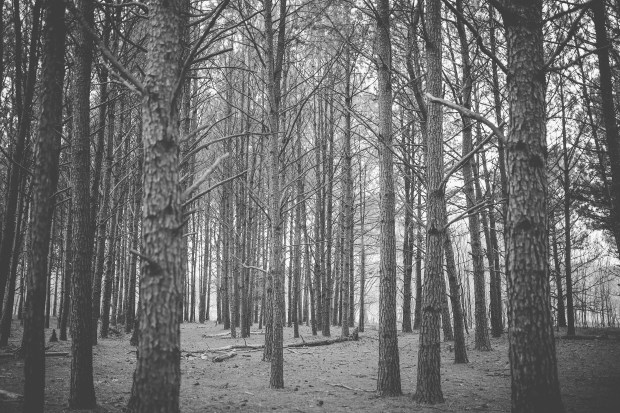
In the dead of winter
When trees are fast asleep
The sap is creeping slowly
From roots frozen in the deep

Branches bare, encrusted
Ice both a prison and an art
Beneath that frigid stillness
What dreams consume their hearts?

Do they dream of sunshine?
Warm rays, caressing light?
Of birds with trilling music?
Fresh clothing, green and bright?

Perhaps they dream of freedom
Of roots pulling out of dirt
Of crossing the horizon
Roaming, watchful and alert

Or are their dreams much darker?
Full of mist and damp and gloom?
Do they conjure ghosts of saplings
To bring careless humans doom?

Or their dreams may be too alien
Thoughts hidden deep like roots that curl
For though we share the same bright planet
We inhabit different worlds

Still I cannot stop returning
I would ask them if I could
What they dream in dead of winter
In this silent, ice-bound wood